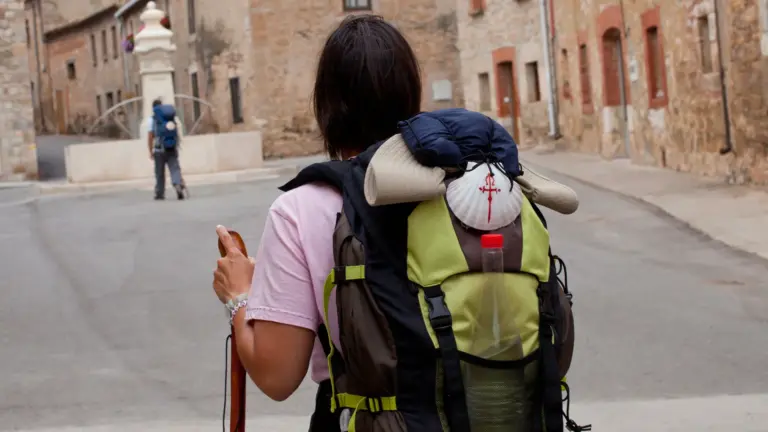
Why is a good physical recovery from the Camino de Santiago necessary?
The Camino de Santiago generates physical wear and tear that accumulates over weeks of walking. Covering 20 or 30 kilometers daily for several days subjects your muscles and joints to continuous stress that does not end until you finish the journey, at the Plaza del Obradoiro.
Undergoing poor physical recovery from the Camino de Santiago can lead to lasting health problems and injuries such as plantar fasciitis, patellar tendinitis, or iliotibial band syndrome. For these reasons, it is recommended to dedicate time and attention to recovery in order to protect the body.
Phases of physical recovery from the Camino de Santiago

Physical recovery from the Camino de Santiago is divided into different phases, which must be respected so that the body regenerates properly; moreover, each stage has its own needs and strategies.
Immediate phase: The first 30 minutes after arriving
The first few minutes after arriving at the Plaza del Obradoiro are important for recovery. As soon as you finish, do gentle stretches of your legs and back to prevent your muscles from cooling down too quickly and tightening up. Hydrate with water or an isotonic drink to replenish fluids and electrolytes, and eat something light with carbohydrates and protein. Additionally, it is advisable to change into comfortable, breathable footwear to relieve pressure on your feet and allow your skin to breathe.
Rest phase: The first day in Santiago
After completing the Camino de Santiago, the first day should be dedicated to active rest. Get as much sleep as you need, as it is the best muscle regenerator. You should also apply cold to inflamed areas for 15–20 minutes, and heat to tense muscles to relax them.
It is recommended to walk slowly around the city, but do not stay in complete rest: gentle movement helps eliminate accumulated toxins and reactivates circulation.
Regeneration phase: The first 3 days
In the first three days after completing the Camino de Santiago, the main goal is to help the muscles eliminate lactic acid and regenerate damaged tissue.
It is recommended to perform gentle joint mobility exercises, such as ankle and wrist circles or heel raises; use foam rollers or a massage ball for self-massage on your calves, quadriceps, and hamstrings. Additionally, contrast baths activate circulation and speed up recovery. Try to over-hydrate.
Nutritional phase: The first week.
Nutrition is essential for proper muscle tissue regeneration. During the first week, increase your intake of high-quality proteins to repair damaged muscle fibers; add foods rich in magnesium and potassium to prevent cramps. Also, keep in mind that supplements such as glucosamine or magnesium may be useful (always consult a professional).
Readaptation phase: The first 2 weeks.

After the first few days, it is necessary to regain lost strength and flexibility. Start doing leg-strengthening exercises, such as squats, lunges, or planks, to reinforce the muscles that have suffered during the journey. Invest time in stretches that cover the entire muscle chain. Resume physical activity progressively: start with gentle walks, then light jogging, and finally, intense exercises.
Prevention phase: Avoiding long-term injuries.
Recovering is not a simple task. To prevent discomfort from turning into chronic injuries, adopt preventive habits. It is necessary to take care of your knees and ankles with strengthening and stability exercises. Establish a weekly exercise routine that includes stretching, strengthening, and joint mobility work.
Warning signs: When to see a professional after the Camino de Santiago.
We may experience various discomforts after completing the Camino de Santiago, and some of them may not be normal. There are different signs that indicate things are not going as expected and that require medical attention. If after several days of rest the pain in your knees or ankles does not subside, it is necessary to consult a specialist. Injuries such as tendinitis or bursitis do not improve without the necessary treatment.
Additionally, persistent cramps or a feeling of weakness in your legs could be the result of an electrolyte imbalance or a significant muscle problem. If you notice swelling, heat, or redness in your legs, see a doctor immediately, as it could be a symptom of venous thrombosis.