Anyone who has walked the French Way knows the importance of the Cruz de Ferro (the Iron Cross of the Camino de Santiago). It is located on a gently sloping hill, the highest point of the French Way.
The views it offers from the top are incredible, and the legends hidden behind the Cross are enough to spark the imagination of any history buff. But above all, the respectful peace of this place is spiritually uplifting even for the non-religious, and travelers yearning to see something unique that reflects much of the Camino’s spirit will find themselves making a stop here.
If you are soon going to walk the Camino de Santiago, this is what awaits you at the Cruz de Ferro.
Legends of the Cruz de Ferro
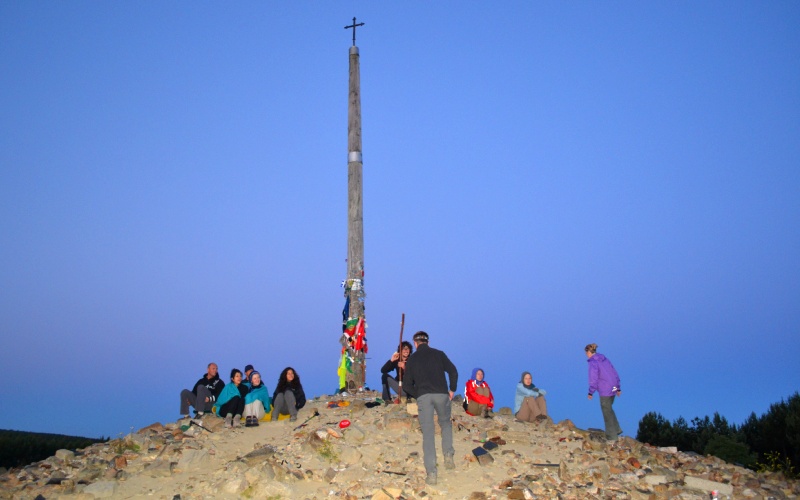
The Cruz de Ferro, located between Rabanal del Camino and Ponferrada, is a mystery even to historians. Erected on a five-meter wooden pole, most people believe it was built for a very practical purpose: to mark the path for pilgrims traveling the French Way during the winter, when everything was covered by a thick blanket of snow.
The landmark rose high enough for anyone walking the path to see it, serving as a welcoming beacon that guided pilgrims to their destination. Although this may have been its original purpose, most people today use it to mark their journey.
Some historians believe that it was a site used by the Celts even in pre-Christian times and that it was part of an unknown ritual, while others believe that the ancient Romans used it to mark a border between two territories.
Speculation abounds, but the most popular belief is that the cross was placed there by the Apostle Saint James himself. As the story goes, Saint James was traveling through the country on one of his evangelical missions when he encountered pagan priests performing a human sacrifice ritual. Filled with righteous anger, he took a stone from his pocket and threw it at the pagan altar. Guided by the Lord, the stone broke the altar into a thousand tiny pieces, and Saint James erected a large cross in its place to mark the power of the Almighty.
Regardless of the actual truth, the Cruz de Ferro is beautiful to behold, and climbing to the top of the hill will allow you to appreciate your surroundings from a different perspective.
Current Traditions
One of the best things about the Cruz de Ferro is that it allows you to take part in a very ancient and liberating tradition. As you approach it, you will see that it is surrounded by small rocks of all shapes and sizes, and most pilgrims who pass by usually say a prayer and place a rock of their own near the cross.
According to custom, if you carry a small piece of your hometown with you, you can place it at the foot of the hill and symbolically “leave your burdens behind.” If you wish, you can say a prayer and enjoy the deep peace that envelops both the hill and the cross.
Others write notes and prayers, leaving them in the cracks at the foot of the cross, and let go of emotional burdens.
How to get to the Cruz de Ferro
Although the climb to the Cruz de Ferro is the highest point on the French Way, it can be easily managed if you take your time and have a good pair of hiking shoes. The ascent begins just after Astorga, where you won’t even notice you are going uphill for several kilometers.
The cross is located in the Mountains of León, in northern Spain, and before reaching it, you will come across some interesting places. Astorga is worth a visit for its Episcopal Palace, designed by Antoni Gaudí, and after passing the Cruz de Ferro, you will see a town called Ponferrada. It is home to the imposing Templar Castle overlooking the river and a large, old square filled with excellent shops and restaurants.
Once you reach the cross, I recommend you take some time to contemplate the scenery, because it is truly magnificent. The entire area is relaxing and breathtakingly beautiful, so be sure to take a mental picture before continuing your journey.