What is the Compostela and who is entitled to it?
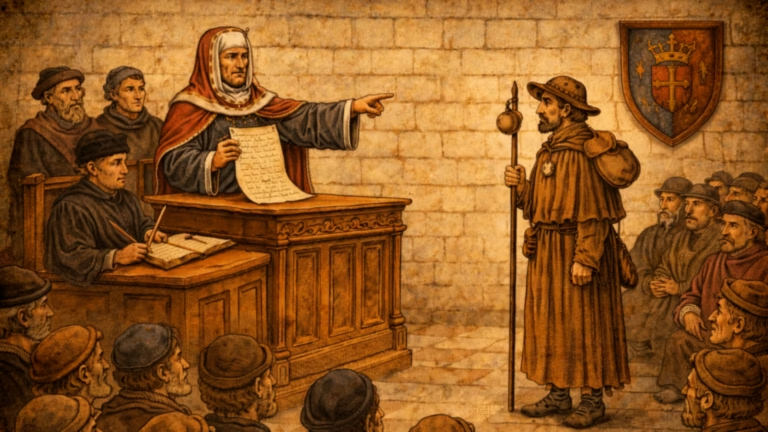
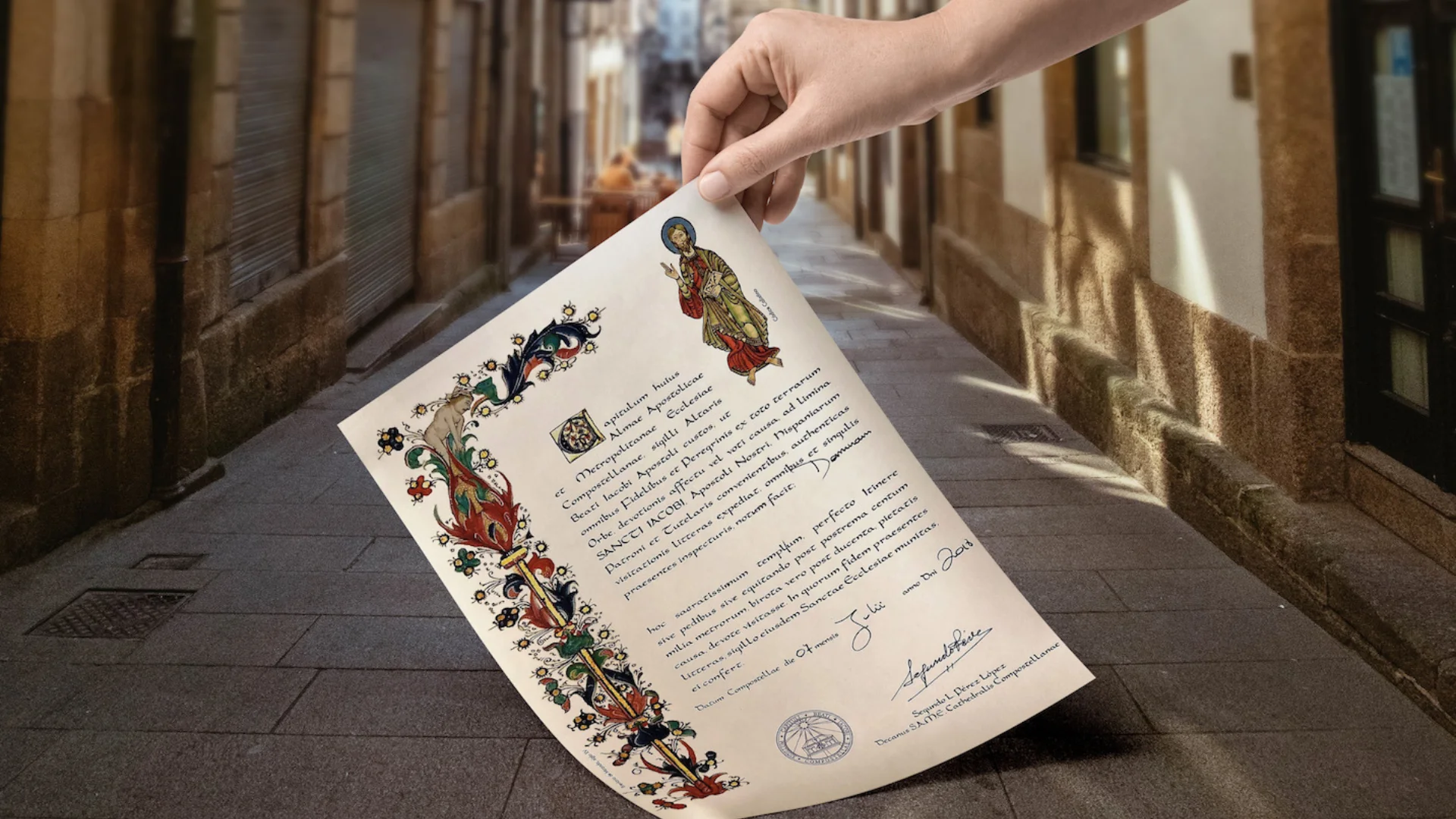
The Compostela is the official document, written in Latin, issued by the Chapter of the Cathedral of Santiago to certify that the pilgrim has completed the Camino de Santiago. It originates in the 14th century—an era when ecclesiastical authorities needed to issue an official safe-conduct so that pilgrims could prove the success of their pilgrimage.
Those who have completed the Camino de Santiago driven by religious or spiritual motives, or with respect for the values of the Jacobean route, are entitled to obtain this document. When processing the document, the staff will ask you what your motivation was; if the reasons are athletic, tourist, or leisure-related, the church will grant you the Welcome Certificate, rather than the traditional Compostela.
It is important to know how to differentiate between the document called the Compostela and the word “compostelana.” This word refers to a woman born or residing in the city of Santiago de Compostela.
Essential distance requirements: How many kilometers do you need to accumulate?
For the Pilgrim’s Office to validate the Compostela, the strictest rule is to prove that you have completed a minimum uninterrupted distance before reaching the gates of the city of Santiago. It is necessary that the final section leading to the finish line matches the mathematically established standards based on your mode of transport.
The rule for pilgrims on foot
If you decide to take on the Camino de Santiago on foot, the church requires you to have walked, at a minimum, the last 100 kilometers of any of the official Jacobean routes.
The rule for “bicigrinos” (cycling pilgrims)
For those who dare to do the Camino de Santiago by bicycle, the rules change. The Chapter requires you to prove that you have cycled, at a minimum, the last 200 kilometers of any of the official Jacobean routes.
The Pilgrim’s Credential: The mandatory passport for your diploma
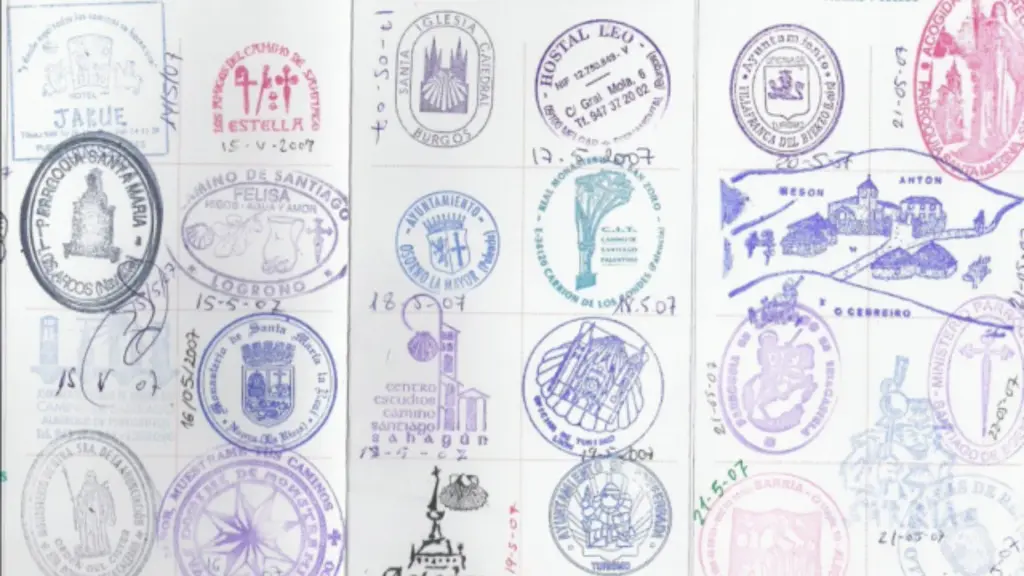
The Pilgrim’s Credential is an official, accordion-style fold-out cardboard document that functions as the official passport of the Jacobean route. Pilgrims are required to obtain it at their point of origin and carry it with them throughout the stages; this allows the ecclesiastical authorities to verify that you have not cheated.
The credential features a series of blank spaces that you must fill with ink stamps from the places you pass through. These stamps can be obtained at hostels, churches, town halls, monasteries, tourist offices, and even bars. Each stamp must be accompanied by the date of the day you visited the location.
The regulations require you to get a stamp at least once a day during the course of the route. Additionally, an anti-fraud control rule applies to the final kilometers, making it mandatory to obtain a minimum of two stamps per day in the spaces of the credential.
Where and how is the Compostela processed upon arriving in Santiago?
How to get the Compostela?
The easiest way to obtain the document is to pre-register digitally through the official Pilgrim’s Office website or by scanning the QR codes located in the hostels of the final stage. You will need to fill out an online form with your personal details, country of origin, mode of transport, and your motivation for the journey, which will generate a unique code. Upon arriving at the office, you will need to request a physical ticket with a calling code for the screens that is linked to your registration, allowing you to wait for your turn in an orderly manner.
Where to get the Compostela?
The process is carried out at the Pilgrim’s Reception Office, a facility managed by the Archbishopric located at Rúa de Carretas, number 33. The venue authorities prohibit entry to the service counters while carrying bulky backpacks, panniers, or bicycles.
What is written on the Compostela?
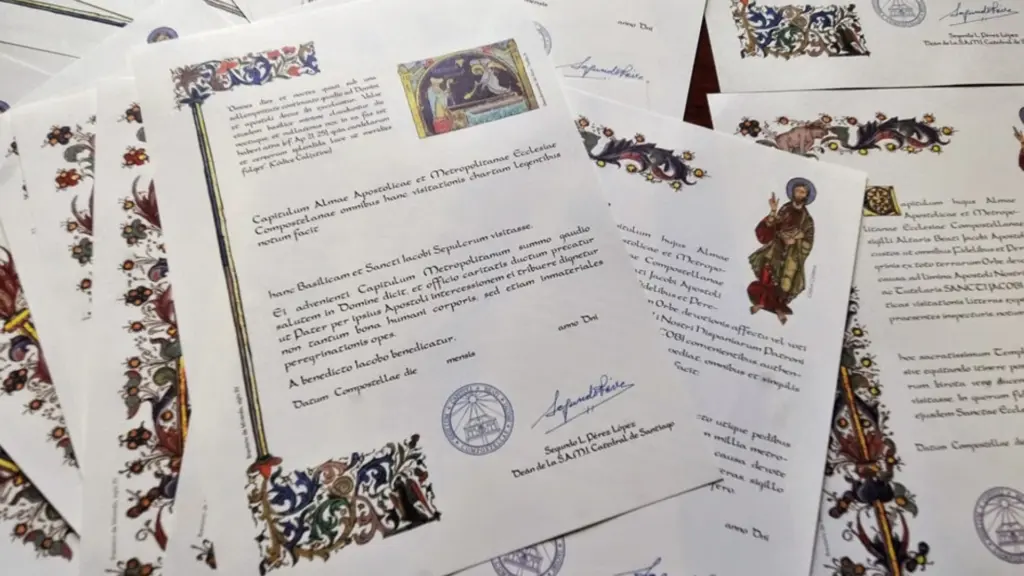
One of the interesting facts about the Compostela is that its official text remains written in Latin, respecting the canons of early medieval ecclesiastical manuscripts. The document begins with a formula of greeting on behalf of the Chapter of the Metropolitan Church of Santiago and proceeds to cite holy scriptures to honor the merit of the pilgrim.
The most striking moment occurs when the office staff hand-write the Latin translation of your name onto the parchment using traditional Gothic calligraphy. The text certifies that you have devoutly visited the sanctuary, and it is finalized with the signature of the Cathedral’s Chapter Secretary and the dry wax seal of the Compostela Chapter.
Along with the traditional Compostela, you can request a complementary document for your wall at home: the Certificate of Distance.
Questions about how to obtain the Compostela
Is the Compostela free of charge?
Yes, the traditional Compostela diploma is free of charge. However, if you wish to obtain the Certificate of Distance with the exact kilometers, you must contribute 3 euros for the maintenance of the Reception Office.
Can I collect the Compostela for a fellow route companion?
No, the collection of the Compostela is strictly personal and non-transferable.