What were papal bulls, and why were they important for the Camino de Santiago?
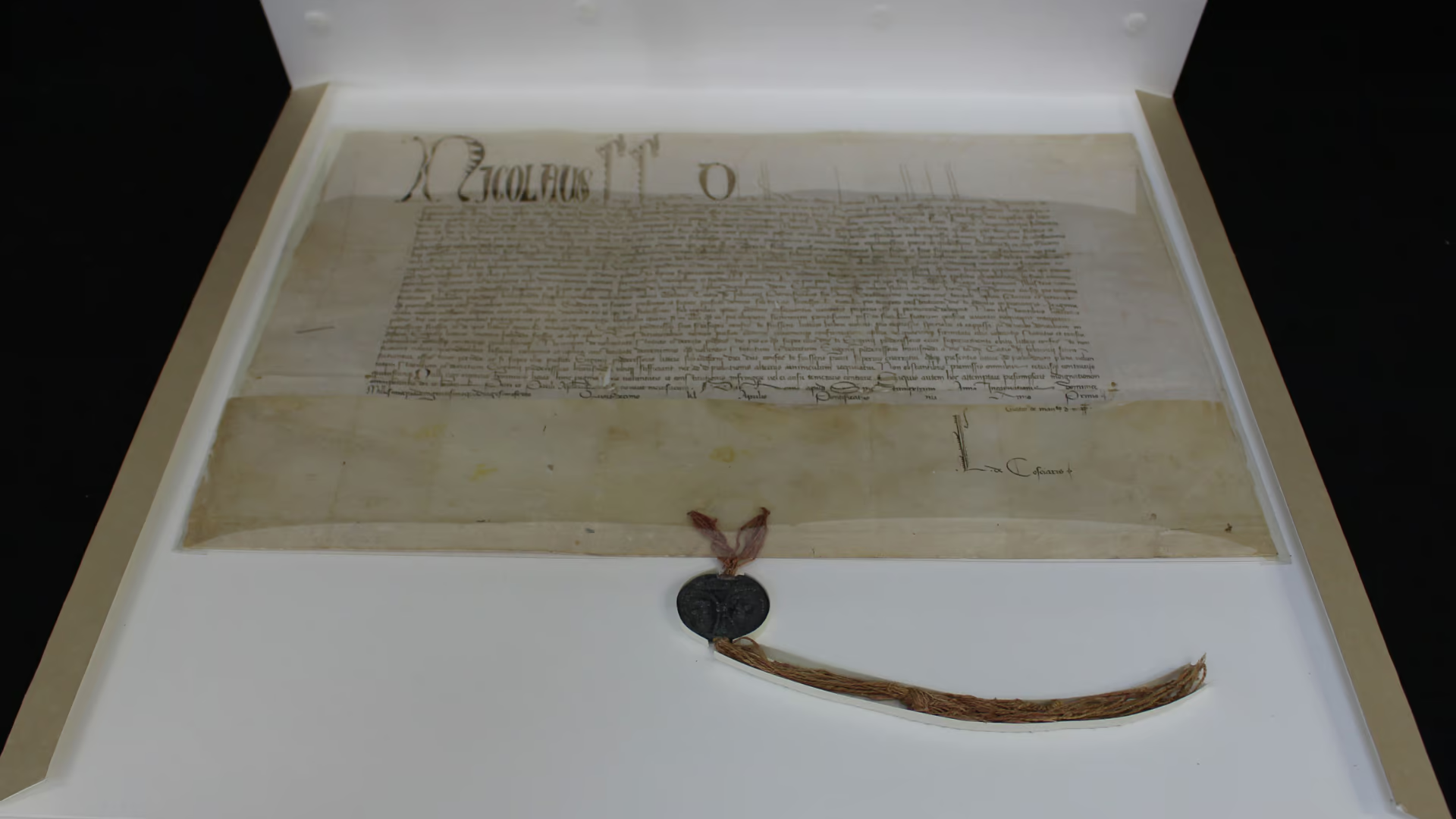
A papal bull was an official document issued by the pope, sealed with a lead bulla that gave it authenticity and solemnity. In the context of the Camino de Santiago, these letters granted spiritual and material privileges to the route and to those who travelled it: indulgences, exemptions, legal protection and confirmation of rights.
For the Compostelan Church, the bulls were proof of its rank, and it used them to defend its independence from other dioceses, to attract pilgrims and to justify the celebration of the Holy Year. Without the bulls, the Camino de Santiago would not have achieved the popularity it came to have.
The first bulls and the origin of the Compostelan Jubilee
The origin of the Compostelan Jubilee is a matter of great debate. Tradition attributes the institution of the Holy Year to a bull of Alexander III, the Regis Aeterni, dated 1179. On the other hand, historians have shown that this document is a forgery produced between the late 15th and early 16th centuries, using two authentic bulls of the same pontiff from 1178 and 1181.
The bulls and important documents for this process are:
- The bull Regis Aeterni (attributed to 1179): A forged document that sought to confirm the Jubilee granted by Callixtus II and confirmed by Eugene III and Anastasius IV. It was authenticated in 1557 by the commissioner general of the Holy Crusade, Juan Suárez de Carvajal, with the authorisation of Pope Paul IV.
- The authentic bulls of Alexander III (1178 and 1181): Used as a model by the forgers to create the Regis Aeterni.
- The bull of Callixtus II: Mentioned in Compostelan tradition as the original grant of the Jubilee, although the documents supporting it are disputed
The forgery was not a whim: the Compostelan Church needed an ancient document to legitimise its Jubilee against the Roman one, instituted in 1300 by Boniface VIII. By dating the Regis Aeterni 121 years before the first Roman Holy Year, Compostela claimed greater antiquity.
The bulls of indulgences and privileges for pilgrims
Papal bulls granted a series of spiritual graces and practical privileges to pilgrims, in order to make the Camino a unique experience. The plenary indulgence was the main attraction: the forgiveness of temporal punishments for sins, which the pilgrim obtained by visiting the Cathedral under certain conditions.
The bulls granted various privileges, such as: the possibility of choosing a confessor, the commutation of unfulfilled vows or exemption from certain religious obligations. They also protected pilgrims in their capacity as such, although the effectiveness of that protection depended on the authority backing it.
The bull Deus Omnipotens of Leo XIII and the revival of the Camino de Santiago
After centuries of decline, pilgrimage was reborn in the 19th century thanks to a discovery and a bull. In 1879 the relics of the Apostle Santiago were rediscovered, and in 1884 Pope Leo XIII promulgated the bull Deus Omnipotens, in which he recognised the authenticity of the relics and reactivated the jubilee indulgences.
In addition, he convened an extraordinary Jubilee for 1885, followed by the ordinary one in 1886, and this gave rise to a movement to recover the Jacobean routes, which would culminate in the declaration of the Camino as a World Heritage Site. Without the Deus Omnipotens, the Camino de Santiago would not have regained its current vitality.
Questions about the papal bulls of the Camino de Santiago
What is the most important bull of the Camino de Santiago?
The most important bull is Deus Omnipotens of Leo XIII (1884), because it was the one that relaunched pilgrimage in the contemporary era by recognising the authenticity of the relics. Historically, the Regis Aeterni is the most popular, even though it is a forgery.
Are the original bulls preserved in archives?
Yes. Copies are preserved in the Archive of the Cathedral of Santiago, such as the Regis Aeterni in its paper and parchment versions, and the bull of Sixtus IV of 1452. There are also related documents in Vatican archives and in other collections.