The Great Certificates of the Santiago Cathedral: The Compostela and the Welcome Certificate
The administrative center of the route is located at the Pilgrim’s Reception Office, managed by the Cathedral Chapter of Santiago de Compostela. Depending on the personal reasons that motivated you to walk the Camino de Santiago, the Cathedral authorities issue two major certificates to prove you have reached your destination.
The Traditional Compostela

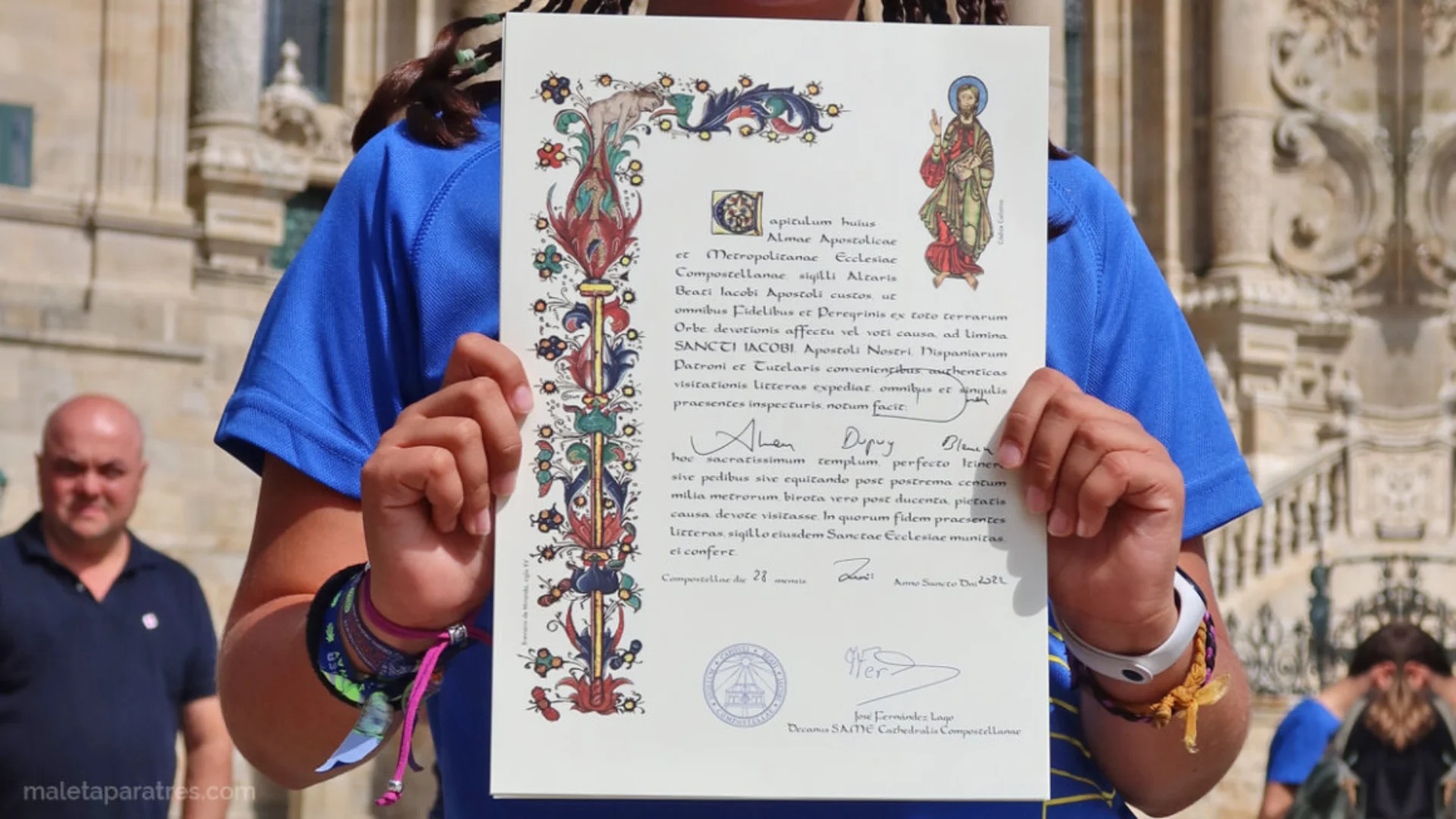
The Compostela is the oldest and most coveted certificate in all of European Christendom, with historical roots dating back to the 14th century. Written entirely in Latin, this parchment certifies that you have completed the journey motivated by reasons of faith, spiritual devotion, or a sincere attitude of inner search and respect for Jacobean values. The office staff will handwrittenly translate your name into Latin before stamping the historical dry seal of the Cathedral Chapter.
The Welcome Certificate
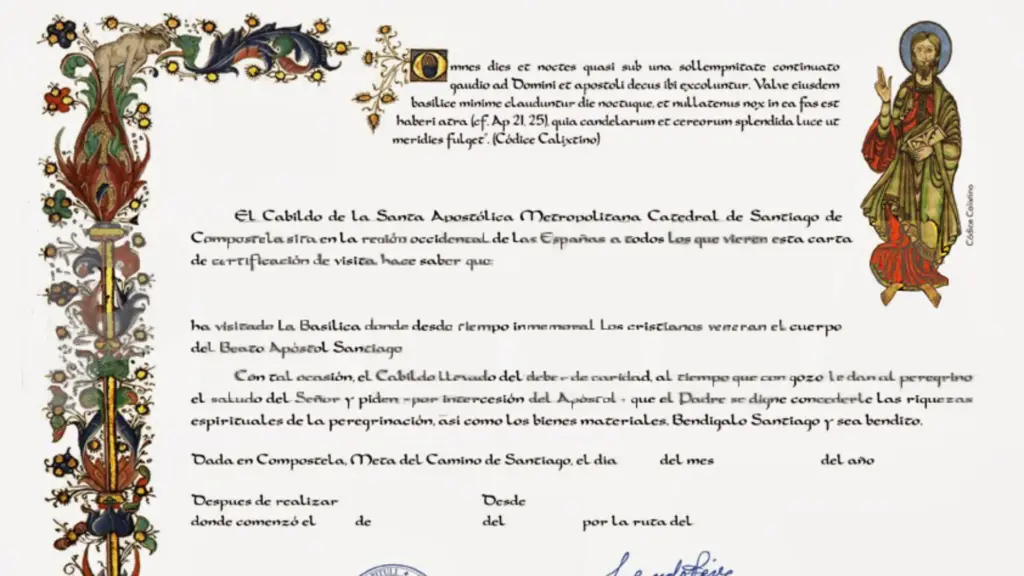
Not all pilgrims walk the Camino de Santiago for religious reasons; many do it as a sporting challenge. For these individuals, the Cathedral of Santiago issues the Welcome Certificate. Written in Spanish, this document officially recognizes the physical and cultural merit of the journey.
Distance Certificate: The Document That Records Your Exact Kilometers
Starting the Camino from the Pyrenean border of Roncesvalles does not carry the same meaning as joining in the final Galician stages. To fill this gap and offer an accurate keepsake, the Cathedral Chapter created the Distance Certificate.
This complementary certificate is a large-format document printed on high-artistic-quality paper. Its lines detail with exact precision the date of your arrival, the town where you started, the specific Camino route you followed, and the exact number of kilometers you completed to reach the Obradoiro.
To obtain this certificate, the process is completed at the Pilgrim’s Office on Rúa de Carretas by presenting your stamped credential. This certificate requires a small fee of 3 euros, an amount destined to cover the office’s running costs.
Route-Specific Certificates: Recognition for Unique Caminos
The Iberian Peninsula features various routes that possess their own management systems and exclusive certificate issuance.
The Fisterrana and the Muxiana: Certificates for the Epilogue at the End of the World
For many pilgrims, Santiago de Compostela is not the end of the Camino, but the beginning of the final epilogue. Continuing the journey toward the Costa da Morte will allow you to obtain two independent certificates:
- The Fisterrana. Which is collected at the municipal hostel in Fisterra after reaching the cape where the ancient world used to end.
- The Muxiana. Issued at the Muxía tourist office after visiting the Sanctuary of the Virgen de la Barca.
The Traslatio Diploma: The Maritime Certificate of the Arousa Way
This certificate commemorates the Traslatio, the fluvial and maritime journey that, according to medieval scriptures, James’s disciples undertook while carrying the saint’s lifeless body aboard a stone boat. To obtain it, pilgrims must complete the Sea of Arousa and Ulla River route; its itinerary requires completing a navigable section by catamaran or motorboat. The certificate is issued by the Arousa Jacobean Route Foundation.
The Salvadorana: Recognition for Crossing the San Salvador Way
The Camino de San Salvador is a demanding route of mountainous beauty that connects the city of León with Oviedo, crossing the Cantabrian Mountain Range via the mythical Pajares Pass. There is an ancient saying that warns the pilgrim: “He who goes to Santiago and not to San Salvador, visits the servant and forgets the Lord.” Upon arriving at the Cathedral of Oviedo, the Asturian ecclesiastical authorities will present you with the Salvadorana, a certificate that rewards one of the most authentic and solitary routes.
Distance Requirements for Certificates: On Foot or by Bicycle?
To obtain these valuable Camino de Santiago certificates, strict compliance with minimum distance regulations is required, designed by the Cathedral Chapter to certify that a true physical sacrifice lies behind the diploma. The Pilgrim’s Office measures these kilometers using official milestones from historical tracks and is inflexible when reviewing the Credencial’s passport of stamps. The rule distinguishes according to your means of transportation:
- If you complete the Camino de Santiago on foot, the Church requires you to certify that you have completed the final 100 kilometers of the route uninterruptedly.
- For cyclists, the Cathedral Chapter raises the bar, requiring you to prove that you have pedaled at least the final 200 kilometers of the route uninterruptedly.