For every pilgrim, there is a precise point on the map where accumulated fatigue vanishes, replaced by pure adrenaline; this spot is called Monte do Gozo.
What is Monte do Gozo and Why Is It Sacred to Pilgrims?
Monte do Gozo is a gentle hill that serves as the final major topographical landmark before entering the urban landscape of Santiago de Compostela. Historically, it stands out for its strategic location, as its summit offers pilgrims their very first and unmistakable panoramic view of the Baroque towers of the Santiago Cathedral.
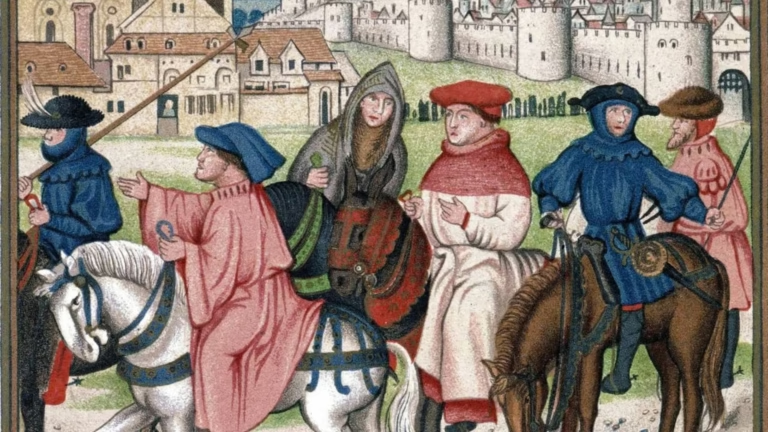
For the medieval pilgrim, the sacred importance of the site was so great that many observed a ritual of removing their boots at this point to walk the final kilometers barefoot to the Apostle’s altar as a sign of humility and gratitude.
The Origin of the Name: Why “Monte do Gozo”?
The name of this hill is a literal translation into Galician of the feeling of joy and emotion that travelers experience upon reaching its summit. In medieval Latin chronicles and even in the Codex Calixtinus, this hill was referred to as Monxoi or Montjoie, a term of French influence.
- The name Montjoie was the battle cry and shout of jubilation used by medieval knights and French travelers when they reached the summit of the hill.
Over time, local phonetics adapted the term, transforming it into “Monte do Gozo.”
The Legend of the “Kings of the Camino”
A curious medieval tradition is known as the legend of the “Kings of the Camino.” When a group of pilgrims tackled this climb, the first member to reach the summit and shout “Monxoi!” upon spotting the cathedral towers was honorarily proclaimed the “King of the Pilgrimage.” This title gave them the right to lead the group’s entry into the basilica and to preside over the table during subsequent celebrations in the City of Santiago.
Where Is It Located and What Is the Arrival Like from the French Way?
Monte do Gozo is situated in the area of San Lázaro, on the eastern edge of the municipality of Santiago de Compostela. It is located at a distance of 4.5 kilometers from the Cathedral. For pilgrims walking the French Way, the hill marks the end of the rural Galician stretch and the beginning of the urban asphalt.
The Camino detours into a vast landscaped and wooded area. The ground changes to dirt and wide stone slabs to welcome the pilgrims.
What Can You See at Monte do Gozo?
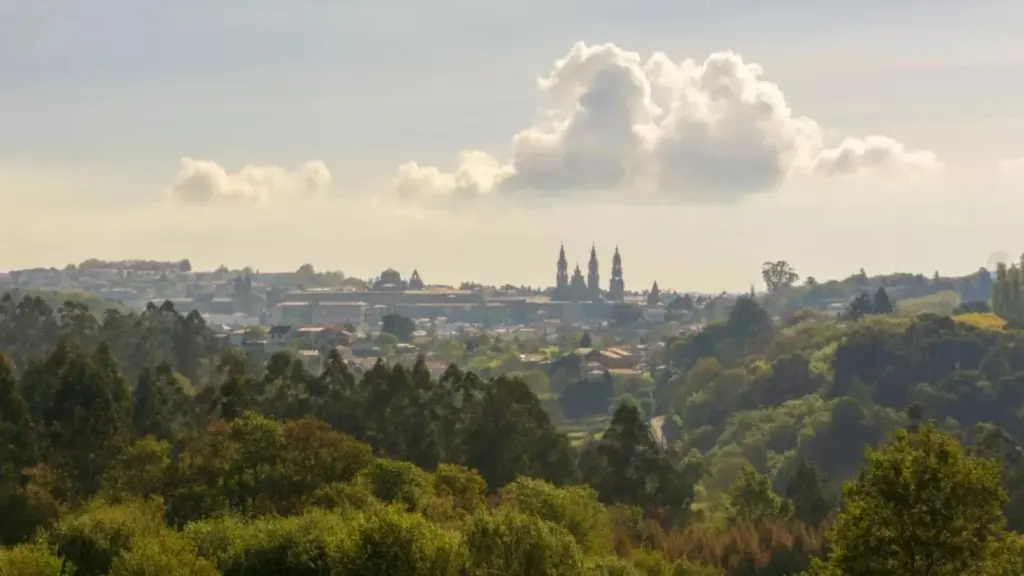
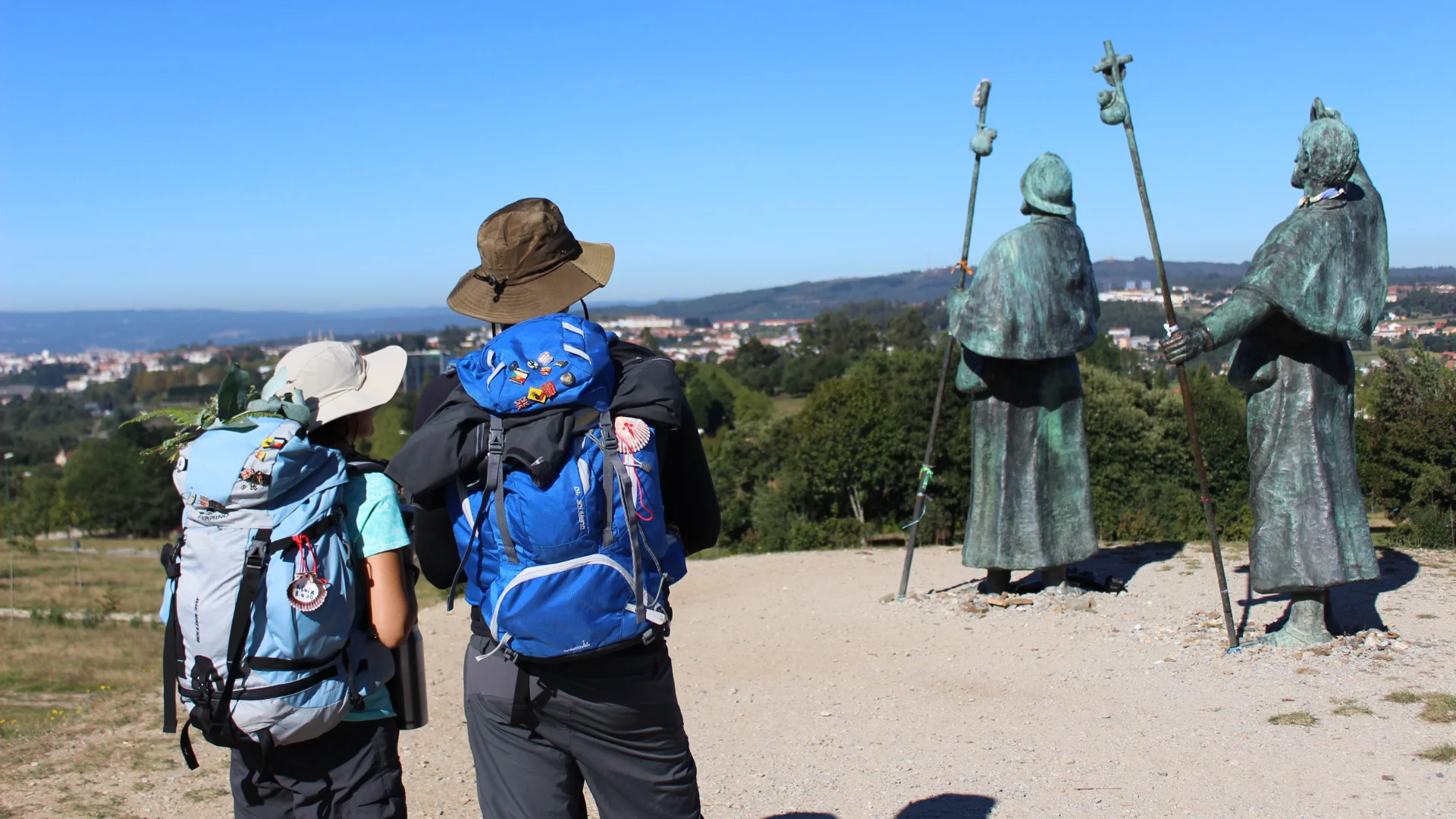
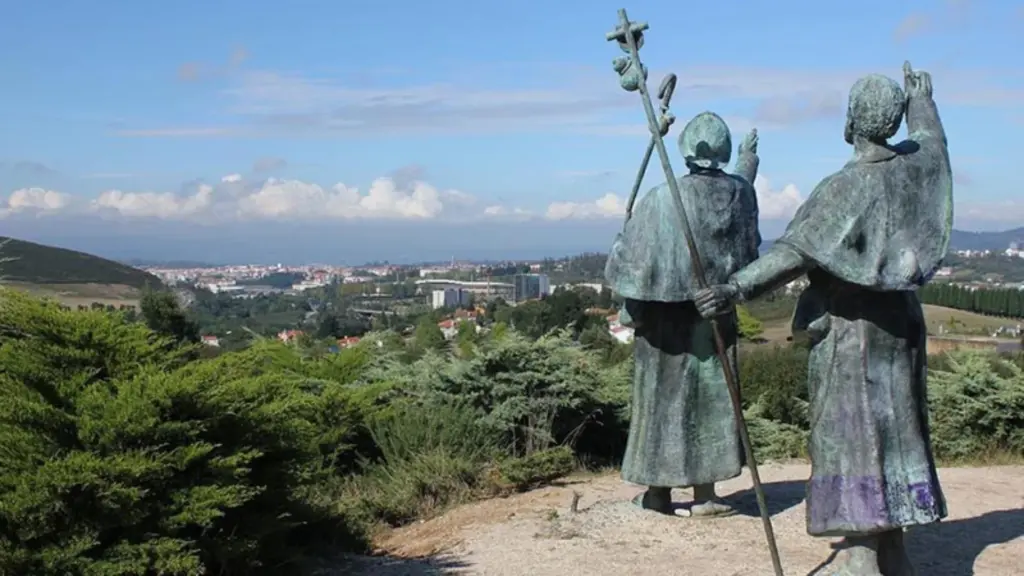
Monte do Gozo has been transformed into a monumental complex. The hill’s most famous landmark is the Pilgrims’ Monument. This monument depicts two life-sized pilgrims pointing toward the horizon with gestures of awe, indicating the spot where the silhouettes of the Santiago Cathedral towers can be seen.
You can also find the massive Monte do Gozo Hostel, built for the Jacobean Holy Year of 1993. Many pilgrims choose this spot to spend their last night, allowing them to rest in a peaceful area and enter Santiago the following day.
In addition, you can see the Chapel of San Marcos at the top of the hill, a temple of medieval origin that served as an immediate place of prayer for pilgrims reaching the summit.
Tips for “Bicigrinos” at Monte do Gozo
For cyclists, Monte do Gozo requires a different logistical approach than for walkers. The first piece of advice is to manage your time pressure and pedestrian traffic. You will find yourself in an area with a very high volume of hikers who are thrilled to be nearing the finish line.
Secondly, check your brakes and the secure attachment of your panniers, as it is a continuous descent with many hikers. The weight of your luggage will increase the bicycle’s inertia when braking on urban pavement, which can become slippery if you encounter orballo (the fine Galician drizzle).