Why are there such tough stages on the French Way?
To determine the toughest stages of the French Way, several factors must be analysed: the accumulated elevation gain, the distance to be covered, the state of the terrain and the availability of services. A 25 km stage on flat ground can be more manageable than a 17 km one with 800 metres of positive elevation gain.
In addition, it must be taken into account that the French Way crosses varied landscapes: from the Pyrenees to the Castilian plateau. Each section has different characteristics and demands; knowing what they are allows pilgrims to plan their itinerary well.
Toughest stages of the French Way
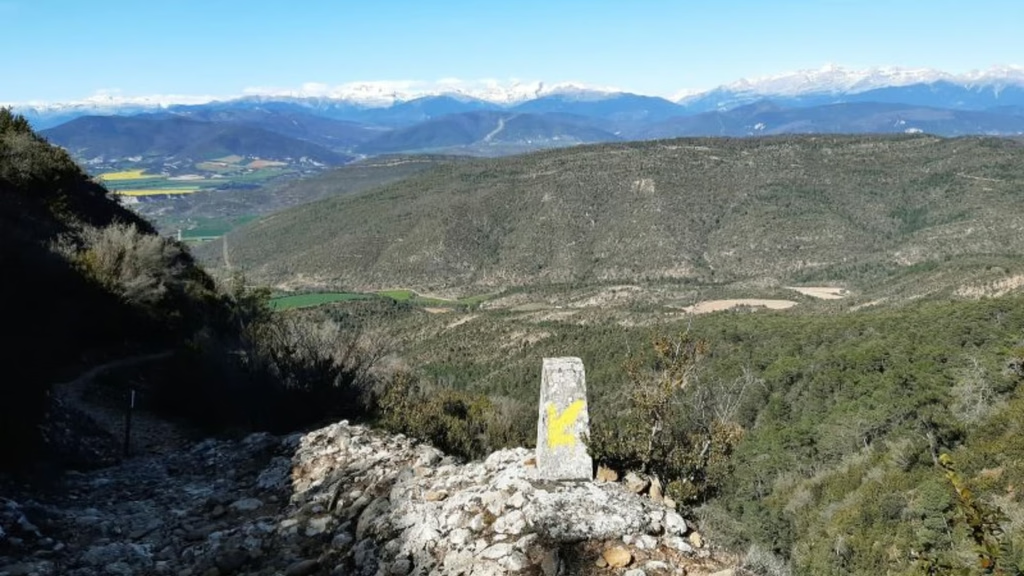
Stage from Saint-Jean-Pied-de-Port to Roncesvalles
It is the first challenge of the French Way, and for most people, the toughest. This stage runs through the Pyrenees, from the French town of Saint-Jean-Pied-de-Port to Roncesvalles, with a positive elevation gain of more than 1,250 metres. The distance varies between 20.5 and 28 km depending on the route chosen.
We can find two options for overcoming this stage.
- The Route Napoleon: shorter but more demanding. This route is spectacular and remains closed in winter due to the risk of snow and ice.
- Valcarlos variant: longer but with less elevation gain.
Regardless of each option, it is essential to set off early, carry water and walk without rushing, enjoying the Camino and pacing your effort.
Stage from Roncesvalles to Zubiri
The descent to Zubiri is a 22 km stage, with a negative elevation gain of more than 500 metres concentrated in the last few kilometres. It has uneven terrain, with loose stones and roots, which demands constant attention to avoid tripping.
This stage provides incredible landscapes, despite the effort it demands, such as: forests, small villages, the sound of the Agra river and the arrival in Zubiri, with its medieval bridge.
Stage from Castrojeriz to Alto de Mostelares
In the middle of the Castilian plateau, you will find the Alto de Mostelares, one of the steepest slopes of the entire route. It has a gradient of 150 metres in barely one kilometre, so steep that most pilgrims have to stop halfway to recover and continue.
Once at the top, you will see a spectacular panorama of the Castilian plateau, with cereal fields and villages. Afterwards, a gentle descent leads to Itero de la Vega, where pilgrims can regain their strength and prepare for the next stage.
Stage from Astorga to Foncebadón
The climb to Foncebadón is one of the worst stages. From Astorga, the route ascends to Monte Irago, where the Iron Cross is located, one of the most prominent places on the pilgrimage. It accumulates an elevation gain of about 500 metres, but the difficulty lies in the length of the ascent.
The landscape along the itinerary is spectacular, from oak and chestnut forests to small uninhabited villages. The arrival in Foncebadón is one of the most rewarding.
Stage from Villafranca del Bierzo to O Cebreiro
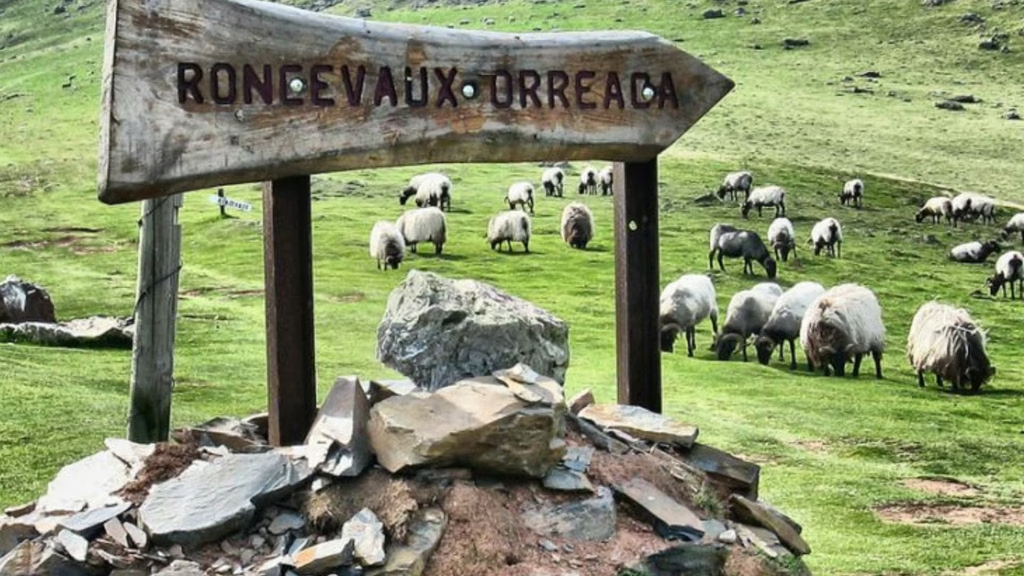
The climb to O Cebreiro is the most mythical and demanding of the Camino. From Villafranca del Bierzo, the route ascends to the 1,300 metres of altitude of O Cebreiro, with an elevation gain of more than 700 metres spread over 30 km. You will find a steep and constant slope, and the heat in the summer months can complicate the ascent.
We can find different variants for tackling this stage, such as the one that passes through the monastery of Carracedo or the one that ascends along the road. In addition, it is the entry point to Galicia, which provides emotional support for the stage: from here on, the goal is close.
Tips for conquering the toughest stages of the French Way
To tackle the toughest stages of the French Way, preparation is required. Here are the most useful tips:
- Split long stages into shorter sections: If a stage is too demanding, it can be split into two easier days.
- Set off early: Getting up early allows you to make the most of the coolest hours of the day and avoid the heat on the climbs.
- Hydration and nutrition: Drink water before you get thirsty and eat something light every hour.
- Listen to your body: Pain is a warning sign; forcing yourself will only make things worse.
- Backpack transport: If the stages are very tough, you can hire a luggage transport service.
- Use poles: Trekking poles reduce the load on your knees and help maintain balance on descents.