Who was Aymeric Picaud?
Aymeric Picaud was a 12th-century French Benedictine monk, originally from Parthenay-le-Vieux, in the Poitou region. Little is known about his life, but he is identified as a clergyman linked to the Jacobean pilgrimage and, according to some sources, personal secretary to Pope Callixtus II.
The monk Picaud made his pilgrimage to Santiago de Compostela on horseback between the years 1130 and 1140. Along the way, he carefully noted everything he saw and experienced: the towns, the monuments, the customs, the dangers, and the quality of the waters. This information he compiled would be captured in his famous work.
The debate over the authorship of the Codex Calixtinus: Was Aymeric Picaud the author?
Traditionally, Aymeric Picaud has been credited with the authorship of the Codex Calixtinus, or at least of its fifth book, called the “Pilgrim’s Guide” (Liber Peregrinationis). The attribution of authorship was based on the mention of his name in the text. However, current historians have questioned this.
The main defender of this theory is the medievalist Bernard Gicquel, who has demonstrated that Picaud was only the compiler of various texts, including the “22 miracles” attributed to Callixtus II. According to Bernard, the author of the Pilgrim’s Guide could be Hugh the Poitevin, a monk from Vézelay, who also wrote the Chronicle of Vézelay. Picaud, then, would have acted more as a compiler than as an author.
What did the Pilgrim’s Guide contain?
Book V of the Codex Calixtinus, known as the “Pilgrim’s Guide” or “Liber Peregrinationis,” is the most famous work associated with Aymeric Picaud. It is a practical guide, designed to help pilgrims along the French Way, with detailed information and advice.
The guide contains a description of the 13 stages of the French Way, outlining the daily sections and pointing out the distances between towns. It also provides a series of tips for the pilgrim: what to bring, how to travel, where to stay, what to eat, and what dangers there are. It also gives detailed information about the customs and character of each town that the pilgrim would encounter.
The legacy of Aymeric Picaud on the Camino de Santiago
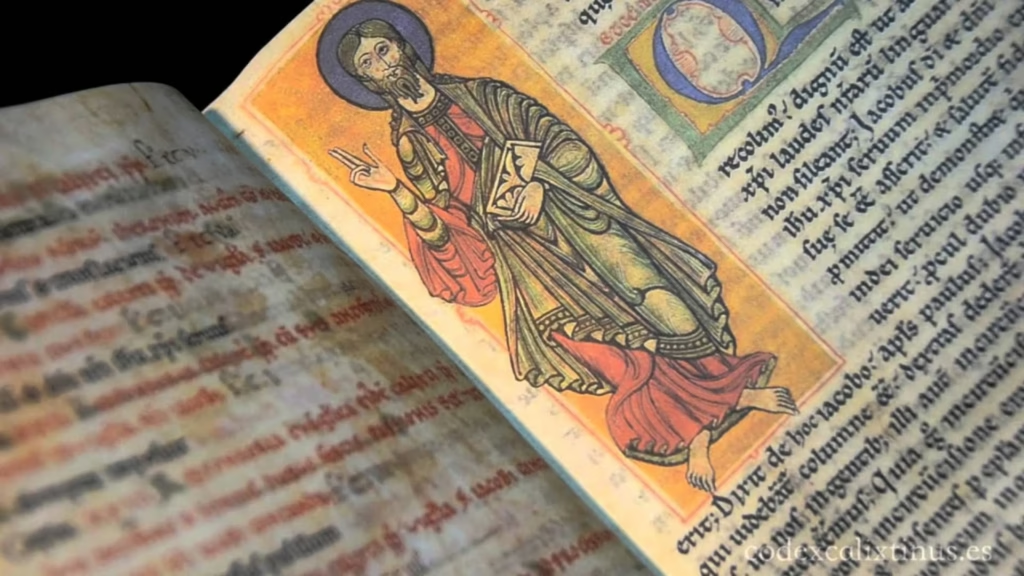
The work of Aymeric Picaud has had a great impact on the Camino de Santiago. His work is considered the first tourist guide to the Camino de Santiago: the “Pilgrim’s Guide.” The influence of this work was decisive in the configuration and consolidation of the French Way as the main route of the Camino de Santiago.
Furthermore, this guide has served as the foundation of Jacobean knowledge. The descriptions of monuments, towns, and medieval customs have been an essential source for historians and pilgrims. Currently, it remains a work of great relevance; its legacy is so significant that there is an international Jacobean journalism award named after him, granted by the League of Associations of the Press of the Camino de Santiago.
Frequently asked questions about Aymeric Picaud
Why did he have a bad opinion of the Navarrese?
Picaud expressed very negative opinions about the Navarrese and Basques in his guide, calling them “impious” and denouncing robberies of pilgrims. This animosity could be due to a traumatic personal experience: it seems he was assaulted by some Navarrese who killed his horses.
How important is his guide for today’s pilgrims?
Picaud’s guide describes the same routes, towns, and monuments that pilgrims travel today. His work remains a historical and cultural reference that allows us to understand the evolution of the Way over the centuries.
Where is the Codex Calixtinus today?
The Codex Calixtinus is preserved in the Cathedral of Santiago de Compostela, although in 2011 it was stolen and recovered the following year. It is currently kept in the Cathedral Archive with reinforced security measures.
Was Aymeric Picaud really the author of the Codex Calixtinus?
Traditionally it was attributed to him, but today he is considered to have been more of a compiler or partial editor. The author of the “Pilgrim’s Guide” could have been Hugh the Poitevin, a monk from Vézelay.