What is EuroVelo 3?
EuroVelo 3 is one of the main arteries of the European cycle route network created by the European Cyclists’ Federation (ECF). It consists of an international route of approximately 5,300 kilometers that crosses the continent from north to south.
Furthermore, as EuroVelo 3 passes through Spain, it becomes the best cycle tourism adaptation of the French Way. This way, the “Bicigrino” is not forced to cross dirt and stone paths, as this network relies on greenways, agricultural tracks, and secondary roads that run parallel to the original Jacobean route.
Why is EuroVelo 3 called the Pilgrims Route?
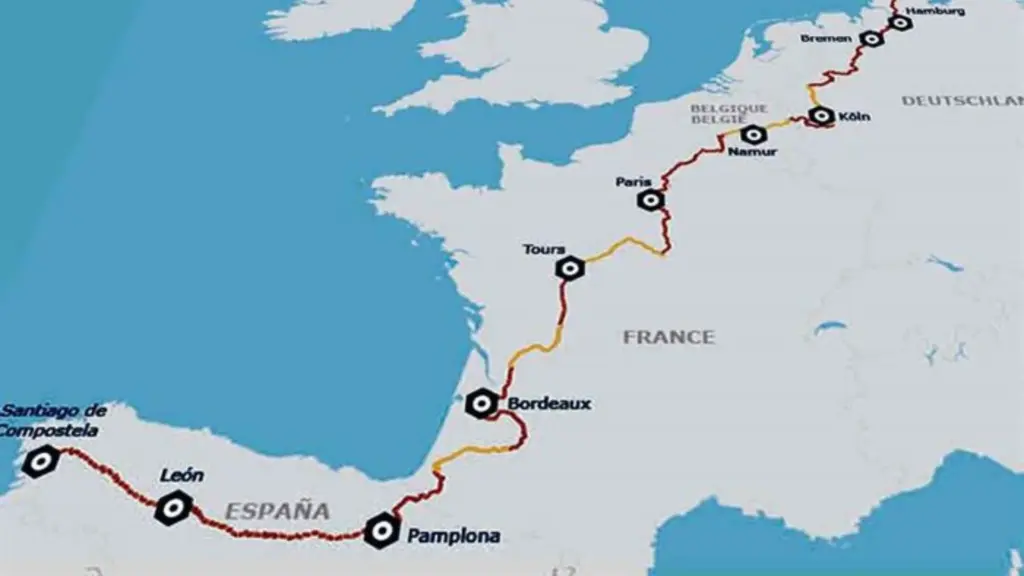
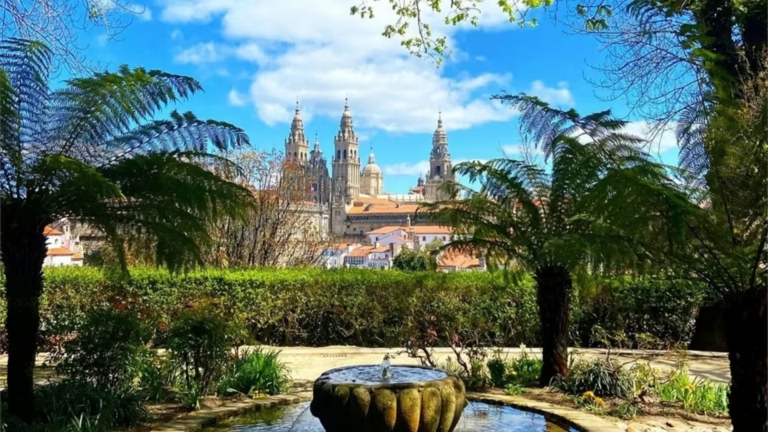
EuroVelo 3 is also known as the “Pilgrims Route” because its design connects cities containing the most relevant sanctuaries of medieval Christianity in Europe. The route begins in Trondheim (Norway), where the remains of Saint Olav are located, and passes through key cities such as Cologne, Aachen, Paris, and Tours before reaching Santiago de Compostela.
Historical Origin of EuroVelo 3
The EuroVelo 3 route was born in 1990 thanks to the European Cyclists’ Federation, with the goal of promoting sustainable tourism and unifying the continent. The idea was to take advantage of old historical and trade routes, providing common signage and connecting sections across different countries.
The ECF decided to consolidate the historical flow of pilgrimage that descended from Scandinavia and Central Europe toward the Iberian Peninsula, transforming the ancient medieval pilgrimage routes into an officially certified cycle path.
Route and Kilometers: The Itinerary of EuroVelo 3
On a global level, EuroVelo 3 passes through seven countries (Norway, Sweden, Denmark, Germany, Belgium, France, and Spain), covering approximately 5,300 kilometers.
At a national level, which is the section that coincides with the Camino de Santiago, it is approximately 800 kilometers from the Pyrenees to the Santiago Cathedral. The design of the route is unbeatable: when the pilgrim’s path is suitable for cycling, the route follows it; when it becomes technical or crowded, EuroVelo 3 diverts the cyclist toward greenways or local roads.
Stages to ride EuroVelo 3 by bicycle through Spain
To cross the Spanish section of EuroVelo 3 by bicycle, the official itinerary is structured into 18 stages. This design is essential for cyclists, as it takes into account both the distance and the elevation gain of each section.
- Stage 1: Organbide – Nagore (42 km / +1030 m)
- Stage 2: Nagore – Pamplona (44 km / +524 m)
- Stage 3: Pamplona – Estella (57 km / +785 m)
- Stage 4: Estella – Logroño (57 km / +785 m)
- Stage 5: Logroño – Nájera (49 km / +649 m)
- Stage 6: Nájera – Santo Domingo de la Calzada (33 km / +408 m)
- Stage 7: Santo Domingo de la Calzada – Belorado (44 km / +544 m)
- Stage 8: Belorado – Burgos (26 km / +340 m)
- Stage 9: Burgos – Castrojeriz (53 km / +567 m)
- Stage 10: Castrojeriz – Frómista (41 km / +268 m)
- Stage 11: Frómista – San Nicolás del Real Camino (52 km / +470 m)
- Stage 12: San Nicolás del Real Camino – León (63 km / +402 m)
- Stage 13: León – Astorga (56 km / +534 m)
- Stage 14: Astorga – Ponferrada (55 km / +911 m)
- Stage 15: Ponferrada – Piedrafita do Cebreiro (49 km / +1,462 m)
- Stage 16: Piedrafita do Cebreiro – Sarria (61 km / +1,876 m)
- Stage 17: Sarria – Melide (70 km / +1,424 m)
- Stage 18: Melide – Santiago de Compostela (66 km / +1,361 m)
Road Surface and Signage: Is EuroVelo 3 a Safe Route?
EuroVelo 3 is a safe route, designed for cyclists to avoid traffic by combining different secondary roads, agricultural tracks, and greenways. This route is marked by both the yellow arrows of the Camino de Santiago and the official European signage: small blue signs with the EU stars and the number 3.
Infrastructure varies by autonomous community. In Navarra and La Rioja, you will find ideal lanes; in Castile and León or Galicia, you will see more shoulders on local roads.
What type of bicycle do you need for the EuroVelo 3 route?
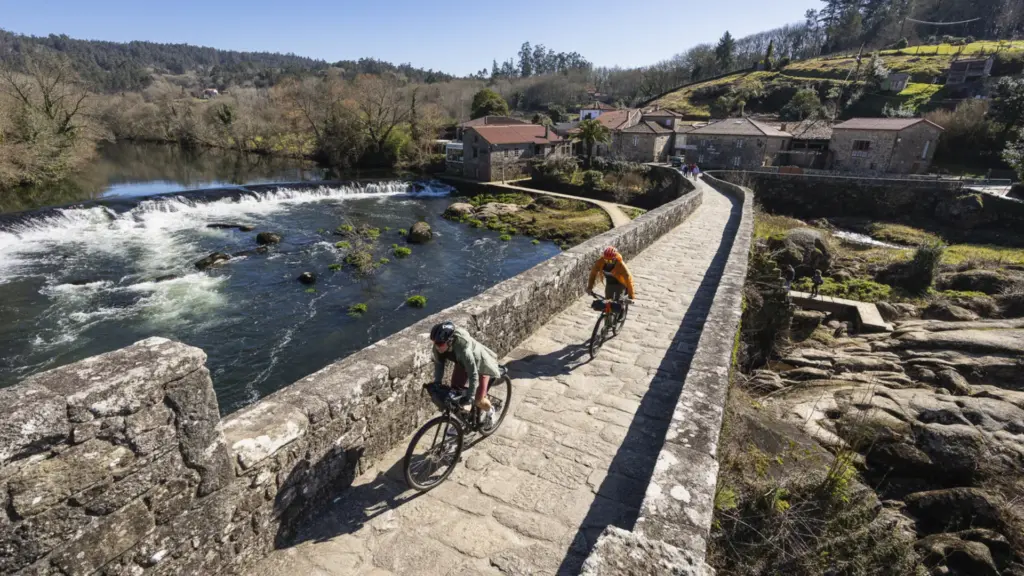
When talking about EuroVelo 3, we can say it is a highly variable route that connects sections of asphalt, gravel, and dirt tracks, where the goal is to find a balance between speed and comfort. These are the best options for the journey:
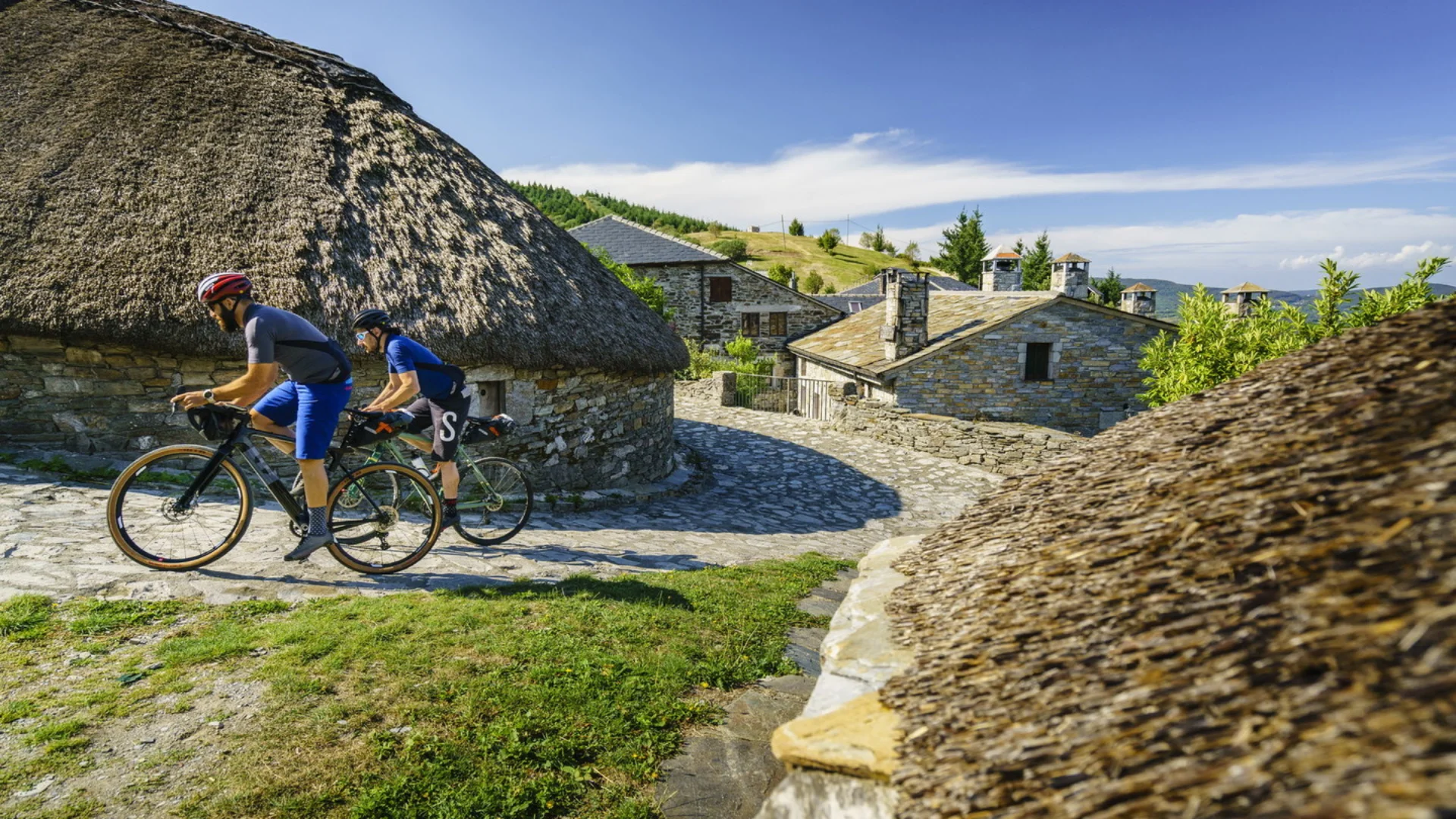
- Gravel or Trekking (hybrid) Bike: These are the best option. Their geometry allows you to ride agilely on asphalt straights while simultaneously absorbing vibrations on forest tracks or greenways.
- Mountain Bike (MTB): A safe bet, provided you use front suspension. It is recommended to avoid very wide or heavily knobby tires.
- Electric Bike (e-bike): The most recommended models are trekking types. This option will save your legs on tough climbs like O Cebreiro.
Hostel Infrastructure and Services on EuroVelo 3
Because it is such a long route crossing seven countries, EuroVelo 3 features an excellent and varied infrastructure. You will find everything from Nordic campsites and small guessties to the classic pilgrim hostels along the French and Spanish sections.
To travel with peace of mind, the safest option is to look for accommodations with official cycling seals, such as Bed & Bike (Germany), Accueil Vélo (France), or Bike-Friendly (Spain). These accommodations guarantee the best services for taking care of your bicycle. In addition, because you are crossing the continent through well-populated areas, your daily supply of food and water is fully assured.