What is a Pilgrim? Meaning and Definition
From an etymological point of view, the word comes from the Latin peregrinus, a compound word formed by per (through) and ager (the field or land). This word was originally used to designate a person who traveled beyond the borders of their territory or hometown. In Roman Law, a peregrinus was a foreigner who lived within the Empire but did not possess Roman citizenship.
Over time, the concept lost its legal weight and acquired a purely geographic and spiritual meaning, defining a pilgrim as anyone who travels on foot or by their own means toward a sacred place or a destination of devotional value.
Through their journey, the pilgrim voluntarily seeks to undergo austerity, uncertainty, and physical effort as tools for internal transformation. The Jacobean pilgrimage is measured by one’s capacity to adapt to the terrain, share the experience with others, and accept the difficulties of the Camino de Santiago.
The Historical Origin of Pilgrims in the Middle Ages

The figure of the Jacobean pilgrim emerged in the first half of the 9th century, following the discovery of the tomb of the Apostle Saint James the Greater in the Libredón woods by the hermit Pelayo. From that moment on, and thanks to King Alfonso II the Chaste (who became history’s first pilgrim by charting the Primitive Way), a migratory wave of faith began.
In medieval society, the pilgrimage to the tomb of the Apostle Saint James served several different purposes:
- On one hand, it was an act of faith motivated by the search for a miraculous healing, the fulfillment of a vow, or the obtaining of a plenary indulgence to forgive their sins.
- On the other hand, there was the figure of the forced pilgrim: criminals condemned by civil or ecclesiastical courts to walk the Jacobean route as a judicial sentence or public penance, forcing them to wear shackles or chains that could only be removed upon kneeling before the Apostle’s altar.
Traditional Attire of the Pilgrim
The traditional attire of the medieval pilgrim was designed for extreme functionality and weather resistance.
- The centerpiece was the esclavina or pelerina (pilgrim’s cape), a short cape made of leather or thick wool worn over the shoulders to protect the torso from the rain and the cold.
- The sayal (tunic), worn beneath the cape, was long and rustic, fastened at the waist by a leather belt from which the limosnero (alms pouch) hung.
- The limosnero (alms pouch) was a small bag intended to keep the coins or bread received through charity.
- Medieval footwear consisted of leather boots fastened with straps or sandals that caused blisters and chafing.
- Wide-brimmed hats turned upward at the front, where the scallop shell was typically sewn.
Nowadays, traditional clothing has been replaced by technical Gore-Tex garments and trekking footwear with cushioned soles, but the essence of carrying only the bare minimum remains intact.
Symbols of the Pilgrim
Over the centuries, the Jacobean tradition has consolidated a series of characteristic symbols for pilgrims.
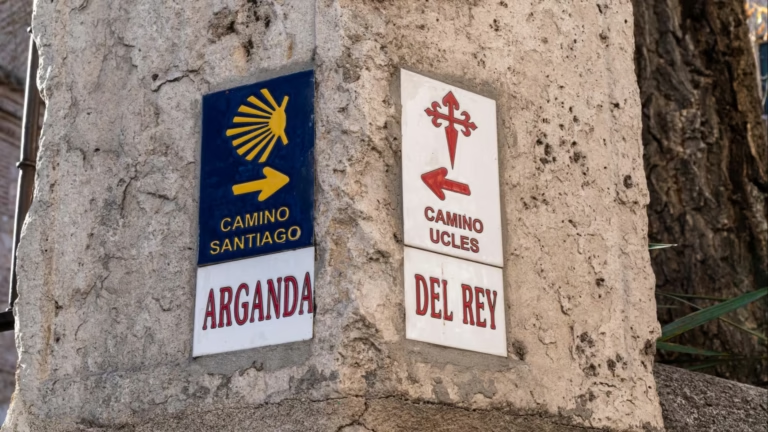
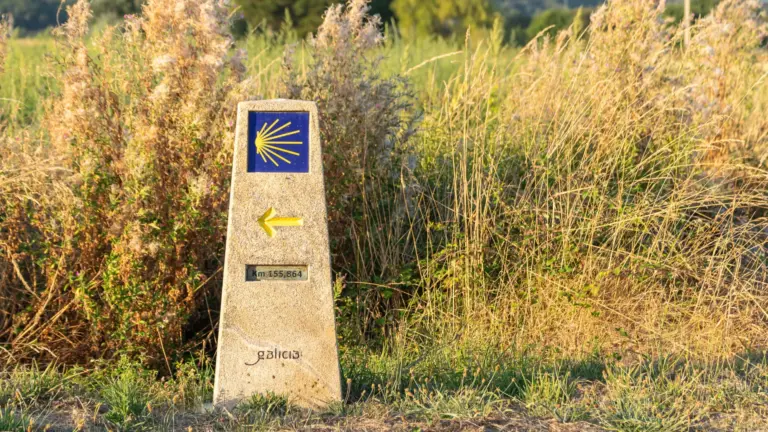
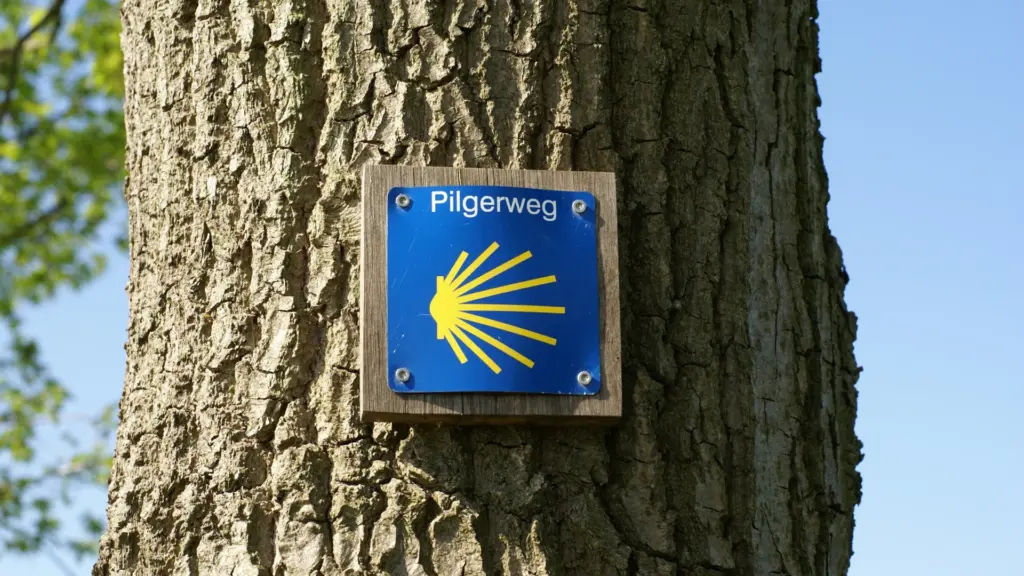
- The universal symbol is the scallop shell. In ancient times, medieval pilgrims collected it on the beaches of Fisterra or Muxía after finishing their journey as physical proof. Over time, this symbol became the official badge of the route, worn visibly as a protective amulet.
- Another symbol is the bordón or wooden staff, carved from hazel or chestnut wood and topped with a gourd that functioned as a canteen to carry water or wine. This symbol served a triple purpose: it was used as a mechanical support, acted as a weapon for self-defense, and possessed a spiritual symbolism.
What does it take to be considered a pilgrim nowadays?
Nowadays, pilgrim status is regulated by ecclesiastical authorities through the Pilgrim’s Reception Office in Santiago. To be formally recognized as a pilgrim and gain priority access to the network of public hostels, it is mandatory to carry the Pilgrim’s Credential. This document functions as a field passport and must be stamped at least once a day (twice if completing the final mandatory section).
To obtain the Compostela (the official Latin document that certifies the pilgrimage), compliance with these administrative rules is mandatory. The minimum distance requirements vary depending on the mode of transportation used:
- Those who complete the Camino de Santiago on foot or on horseback must certify a minimum of 100 continuous kilometers to the cathedral.
- For cyclists, the minimum is non-negotiably raised to 200 kilometers.
Additionally, it is required that the reasons for the journey align with religious or spiritual purposes, or an inner search and cultural respect.