What was a cardinal legate?
A cardinal legate was a direct representative of the pope, sent to a particular region to act in his name. He was an alter ego of the pontiff, with authority to reform, judge and resolve conflicts in the diocese he visited. His figure was essential in the Middle Ages, when distance and the lack of communications made it difficult for Rome to manage all matters.
The legate a latere was the highest category of papal legate. He was called this because he was sent “to the side” of the pope. His powers included visiting the diocese, presiding over councils, resolving ecclesiastical disputes and the ability to make decisions in the name of the pontiff. On the Iberian Peninsula, these legates played an essential role in implementing the Gregorian reform.
Why did the pope send cardinal legates to the Iberian Peninsula?
The pope sent cardinal legates to the Iberian Peninsula for two main reasons:
- To reform a Church that was weighed down by vices.
- To resolve the conflicts that arose between the different Christian kingdoms.
The Hispanic Church of the 11th and 12th centuries needed renewal, because of various problems such as: simony, the marriage of clerics and the interference of laypeople in episcopal appointments. The Gregorian reform sought to eliminate these problems.
To all this situation, one must add the political problems of the Iberian Peninsula. The different kingdoms were in constant conflict, and the disputes between them affected the dioceses and the pilgrimage routes. The papacy needed someone with authority to mediate in disputes and to guarantee that the Church would not be dragged into the wars of the kingdoms.
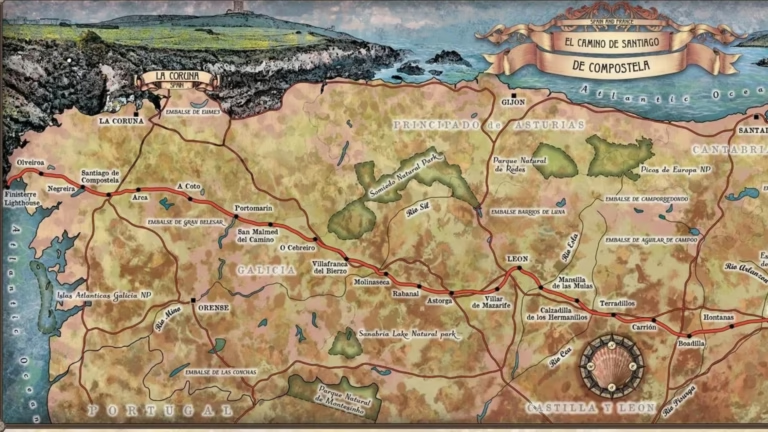
What did cardinal legates do on the Camino de Santiago?
Cardinal legates travelled the Camino de Santiago with specific objectives. These were their main actions:
- To visit Compostela and venerate the Apostle: Cardinal Bosón arrived in Compostela in the spring of 1121 to visit the tomb of Santiago before convening the Council of Sahagún.
- To preside over councils in cities along the Camino: There are different cities on the Iberian Peninsula where the legates convened councils to reform the Hispanic Church.
- To resolve conflicts between kingdoms and dioceses: The legates mediated in territorial disputes between bishoprics and in conflicts between the kings.
- To protect pilgrims: The legatine councils included specific canons to protect pilgrims and the property of the Church.
- To summon the bishops to general councils: Cardinal Guido de Lescar was sent in 1139 to summon all the Spanish bishops to the Second Council of the Lateran.
The most important cardinal legates of the Jacobean route
During the 11th and 12th centuries, various cardinal legates left their mark on the Camino de Santiago. Here are the most notable ones:
- Cardinal Richard: Papal legate in Spain from 1078, he presided over the councils of Palencia and Husillos and was an important figure in the ecclesiastical reorganisation of the Iberian Peninsula.
- Cardinal Bosón: He convened and presided over the Council of Sahagún in 1121, after visiting Compostela and venerating the Apostle’s tomb. Its twelve canons imposed the Gregorian reform and declared the interdict over the kingdoms of Spain.
- Cardinal Deusdedit: Sent to Spain in 1123 by Callixtus II, he sought concord between the Hispanic princes and presided over the Council of Valladolid.
- Cardinal Guido de Lescar: Legate on several occasions, he presided over the Council of Burgos in 1136 and summoned the Spanish bishops to the Council of the Lateran.
- Cardinal Gregory of Ostia: Although his legation was earlier (first half of the 11th century), his figure is linked to the ecclesiastical organisation of La Rioja and Navarre, territories on the Camino.
What changed with the passage of the cardinal legates along the Camino?
The passage of the cardinal legates along the Camino de Santiago left major changes in the Hispanic Church and on the Jacobean route.
- The first change was the reform of the clergy’s customs: the legatine councils imposed measures against simony, the marriage of clerics and lay investiture, laying the foundations of a disciplined Church.
- The second change affected the protection of pilgrims. They included specific provisions to protect walkers and the property of the Church, reinforcing the legal security of pilgrimage.
- The third change was the consolidation of papal authority over the Hispanic Church: the legates demonstrated that Rome could intervene in peninsular affairs, and their work prepared the ground for the integration of the Spanish Church into the Roman orbit.