What is the Piedmont Way?
The Piedmont Way is a Jacobean itinerary that runs along the foothills of the Pyrenees on the French side, connecting the different routes that crossed the mountain range to access the Iberian Peninsula. Its name comes from the French expression Piémont (from the medieval Latin Pedemontium), which refers to its mid-mountain route.
This route starts in the city of Narbonne and ends in Saint-Jean-Pied-de-Port, covering approximately 500 kilometers through the regions of Languedoc, Bigorre, and Béarn.
Currently, many hikers and cyclists take advantage of the route to travel from Gruissan beach (in the Gulf of Lion) to Hendaye (in the Bay of Biscay), which totals approximately 600 kilometers.
What is the historical origin of the Piedmont Way?
The Piedmont Way was used before the 11th century, during the Middle Ages, when European pilgrims sought the safest routes to cross the Pyrenees. More than 20 passes commonly used by pilgrims between the 11th and 14th centuries have been documented.
Pilgrims chose one route or another depending on factors such as: the presence of snow, river flooding, and the existence of hospitals and monasteries where they could stay. During the Middle Ages, the Piedmont Way contained numerous pilgrim hospitals, among which the ones at the Cistercian abbey of l’Escaladieu, Mifaget, and L’Hôpital-Saint-Blaise stood out.
Route, Distance, and Kilometers: Where does it start and what does it pass through?
The Piedmont Way runs parallel to the Pyrenees on its French side, from Narbonne on the Mediterranean coast to Saint-Jean-Pied-de-Port in the French Basque Country.
- Stage 1: Narbona – Carcasona (60 km)
- Stage 2: Carcasona – Montreal (20 km)
- Stage 3: Montreal – Fanjeaux (15 km)
- Stage 4: Fanjeaux – Pamiers (30 km)
- Stage 5: Mirepoix – Pamiers (30 km)
- Stage 6: Pamiers – Le Mas-d´Azil (25 km)
- Stage 7: Le Mas-d´Azil – Saint-Lizier (25 km)
- Stage 8: Saint-Lizier – Castillon-en-Couserans (18 km)
- Stage 9: Castillon-en-Couserans – Saint-Bertrand-de-Comminges (25 km)
- Stage 10: Saint-Bertrand-de-Comminges – Bagnères de Bigorre (45 km)
- Stage 11: Bagnères de Bigorre – Lourdes (20 km)
- Stage 12: Lourdes – Saint-Pé-de-Bigorre (25 km)
- Stage 13: Saint-Pé-de-Bigorre – Oloron-Sainte-Marie (30 km)
- Stage 14: Oloron-Sainte-Marie – L´Hôpital-Saint-Blaise (20 km)
- Stage 15: L´Hôpital-Saint-Blaise – Mauléon-Licharre (25 km)
- Stage 16: Mauléon-Licharre – Saint-Jean-Pied-de-Port (30 km)
What are the infrastructures and hostels like on the Piedmont Way?
The Piedmont Way is a route in full recovery, so its infrastructures are somewhat limited. The hostel network is scarce, although more rural accommodations are increasingly being found.
Most municipal hostels close at the end of October, so it is recommended to contact the hospitaleros in advance outside of the peak season. Planning the stages and booking accommodation in advance is necessary. In some towns, it is necessary to extend the stage or be self-sufficient for 2 to 3 days in terms of food.
Places and monuments along the Piedmont Way
Along the course of the Piedmont Way, you will find different monuments and places of interest that recall the importance of the Jacobean routes:
- The fortified city of Carcassonne: one of the best-preserved medieval cities in Europe.
- The collegiate church of Montreal: a 14th-century fortified church that was formerly a pilgrim hospital.
- The Cathedral of Saint-Lizier: An 11th- to 13th-century cathedral, containing the Treasure of the Bishops of Couserans.
- The Cathedral of Saint-Bertrand-de-Comminges: a jewel of the heritage of Haute-Garonne, with its cloister and its great Renaissance organ.
- The basilica of Valcabrère: a Romanesque church next to the cathedral, where the grave of a 14th-century pilgrim was found with his staff and scallop shell.
- The abbey of l’Escaladieu: a 12th-century Cistercian abbey, whose name means “God’s Ladder.”
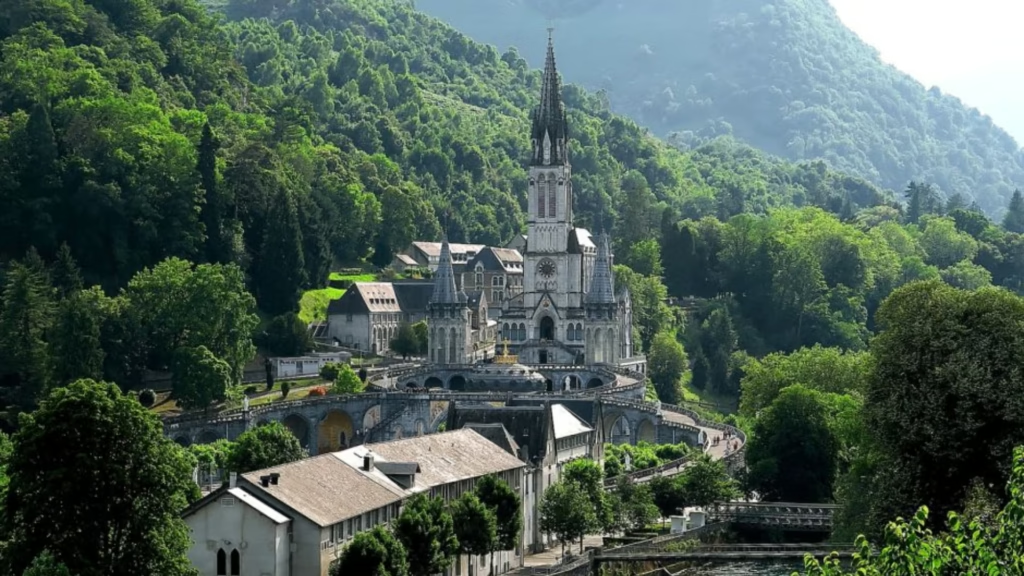
- The Sanctuary of Lourdes: one of the most visited pilgrimage sites in the world.