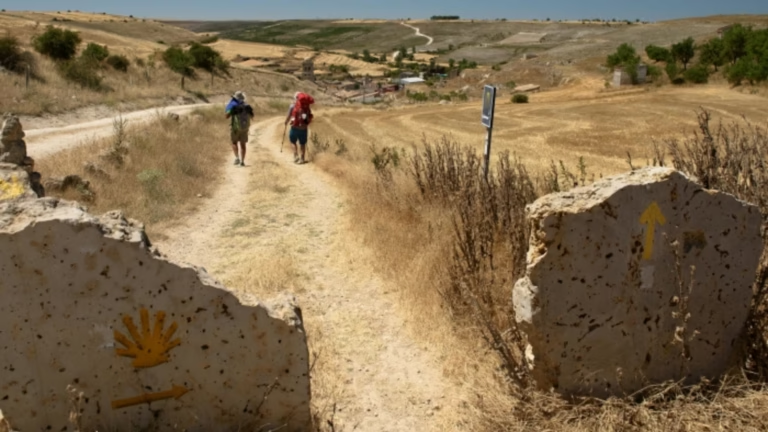
What is the Cistercian Route?
The Cistercian Route is an itinerary (GR-175) that connects the three great Cistercian monasteries of Catalonia: Santes Creus, Poblet, and Vallbona de les Monges. The route runs through the Tarragona regions of Alt Camp and Conca de Barberà, and the Lleida region of Urgell.
It is a route that can be done either on foot or by bicycle, and it is perfectly signposted with the characteristic white and red marks of GR trails. For cyclists, there is the advantage that the itinerary has cyclable variants, designed to avoid the most technical trail sections.
What is the historical origin of the Cistercian Route?
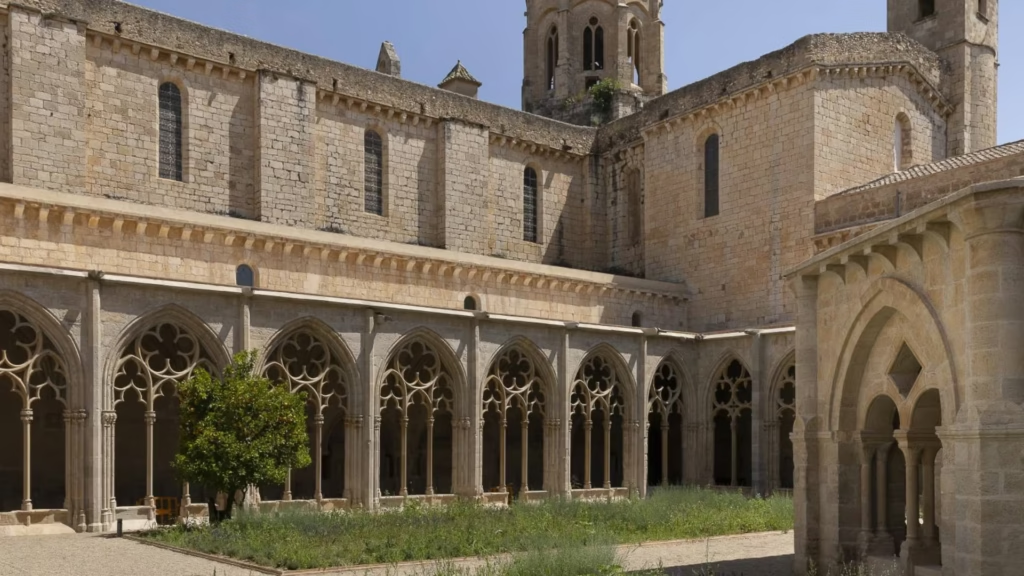
The origin of this territory dates back to the 12th century, when the Cistercian order began its expansion across the Iberian Peninsula. The Catalan counts and the kings of the Crown of Aragon financed the construction of these monasteries with a clear objective: to establish Christianity in the region and repopulate territories that had just been reconquered.
The creation of the tourist route is more recent; it was born in 1989 as an initiative to connect these three wonderful jewels and revive the economy of small rural municipalities. Years later, in 1998, the route was officially established as the long-distance trail GR-175.
Route, distances, and kilometers: Where does the Cistercian Route start and where does it pass through?
The Cistercian Route forms a triangle of approximately 105 kilometers. Since it is a completely circular route, you can start and finish it at the point that suits you best, although the usual practice is to start the journey in the walled town of Montblanc or at the monastery of Santes Creus.
If you want to do the route on foot, it is recommended to divide the trail into 4 or 5 days. If you are a cyclist, you can complete the loop in a weekend (2 or 3 stages).
To design your own roadmap, here are the 4 classic stages:
- Stage 1: Monasterio de Santes Creus – Montblanc (25,5 km)
- Stage 2: Montblanc – Monasterio de Poblet – Vallbona de les Monges (26 km)
- Stage 3: Monasterio de Vallbona de les Monges – Rocafort de Queralt (23,5 km)
- Stage 4: Rocafort de Queralt – Monasterio de Santes Creus (30 km)
What are the infrastructures and hostels like on the Cistercian Route?
On the Cistercian Route, you will depend exclusively on private accommodations. As the towns are small and spaces are limited, it is advisable to book in advance.
A great advantage of this route is that you can stay at the guesthouses of the monasteries of Poblet and Vallbona de les Monges. Regarding services, you will find towns frequently to buy food and fill your water bottles at fountains and local shops.
Places and monuments along the Cistercian Route
The Cistercian Route stands out for being a journey with immense architectural heritage. The most notable feature of the route is the famous triad of monasteries that gives the route its name:
- Monastery of Santa María de Poblet: The largest inhabited Cistercian monastery in Europe, declared a UNESCO World Heritage Site. Its imposing church, cloister, and royal pantheon where the monarchs of the Crown of Aragon rest are particularly noteworthy.
- Monastery of Santes Creus: It is the only one of the three that no longer houses monastic life. This allows tourists to explore spaces that are normally closed without restrictions, such as the Gothic cloister and the monks’ dormitories.
- Monastery of Vallbona de les Monges: A female monastery that has been inhabited for over 800 years. It perfectly blends Romanesque and Gothic architecture.
Apart from this triad of monasteries, the route also offers you other monuments:
- The walled town of Montblanc: A town with its medieval enclosure, perfectly preserved. Catalan popular legend places here the famous battle in which Saint George defeated the dragon.
- The “Cathedrals of Wine”: Throughout the different stages, you will pass by spectacular wineries, such as the one in Rocafort de Queralt, designed by a disciple of Gaudí.