What is the Botafumeiro?
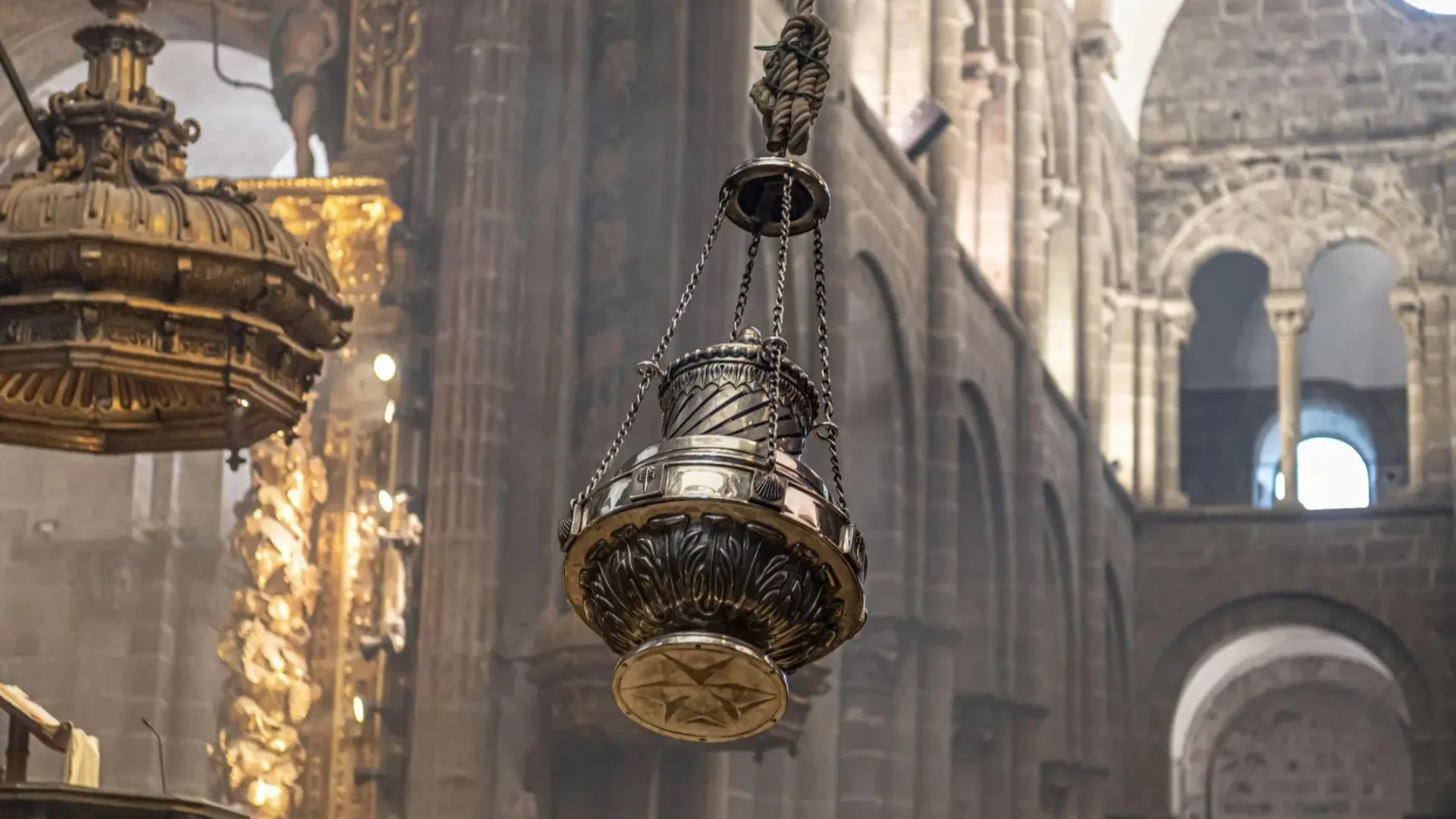
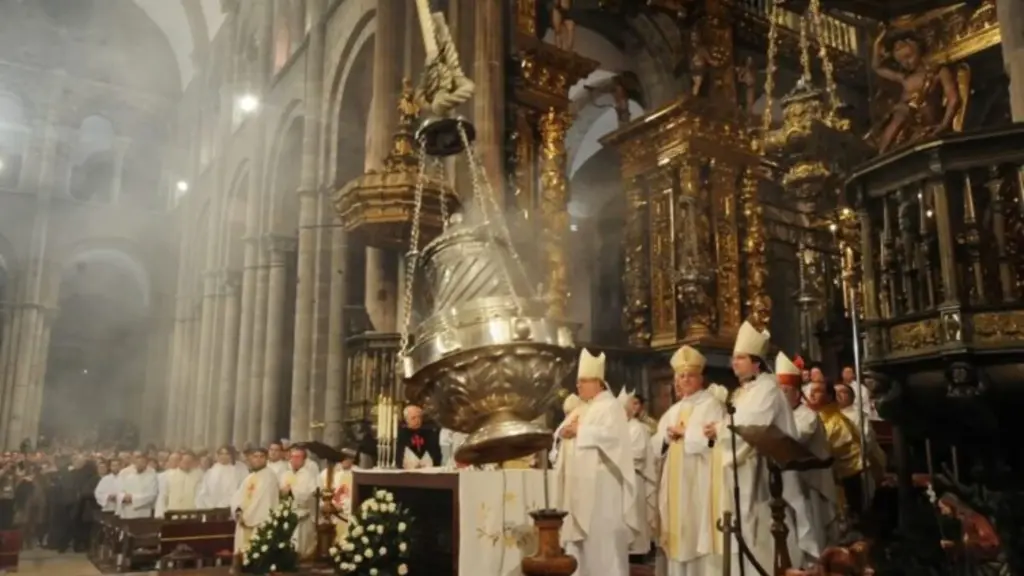
The Botafumeiro is the largest and most famous censer (thurible) in the world. Its name originates from Galician and means “smoke expeller”. This artifact, made of brass and plated in silver, hangs from the central dome of the Santiago de Compostela Cathedral and is swung along the transept by means of a pulley system.
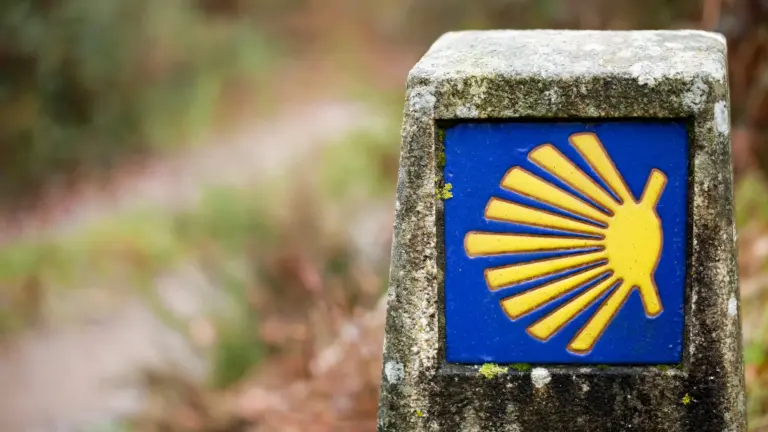
In addition, for pilgrims, the Botafumeiro is a living symbol of the Camino de Santiago that represents purification and celebration after the grueling effort of the journey.
What is the historical origin of the Botafumeiro?
The origin of the Botafumeiro dates back to the 11th century, during the Middle Ages. In the old days, the Santiago Cathedral would fill with pilgrims who arrived exhausted and with very poor hygiene after months of walking. The cathedral was even used as a massive dormitory for many of these pilgrims.
To eliminate the foul odor that concentrated inside the cathedral, the Botafumeiro was devised. The incense smoke acted as a natural air freshener and, at the same time, served a function of spiritual purification.
Characteristics of the Botafumeiro: Weight, dimensions and speed
Watching the Botafumeiro in action is unmatched; its perfect movement and the force it generates impress all pilgrims. To help you understand the magnitude of the Botafumeiro, here are the technical details:
- Empty weight: 53 kilos.
- Operating weight: 62 kilos when it is filled with burning charcoal and incense.
- Height: It measures 1.50 meters tall.
- Maximum speed: 68 km/h at the lowest point of its trajectory.
- Flight amplitude: It describes a 65-meter arc along the transept of the cathedral.
- Maximum flight height: It rises up to 21 meters, almost touching the vault of the temple.
- The rope: It is held by a custom-made rope that is about 65 meters long and 5 centimeters thick.
The “Tiraboleiros”: Who are the ones in charge of moving the Botafumeiro?
To be able to move the Botafumeiro at nearly 70 km/h, a great deal of strength and precision is required. Those in charge of moving the Botafumeiro are called “Tiraboleiros” (the censer pullers), a group composed of eight men dressed in their characteristic red robes.
The process to move the censer is teamwork; after tying the censer to the central rope, the Tiraboleiro Mayor gives it the first manual push. From that moment on, the eight men pull the side ropes downward at the exact moment the Botafumeiro passes through the lowest point.
This procedure coordinates the radius of the pendulum and gives it a massive kinetic impulse, causing the Botafumeiro to reach its maximum height and speed in just a minute and a half, after 17 swinging cycles.
Botafumeiro Schedules: When can it fly?
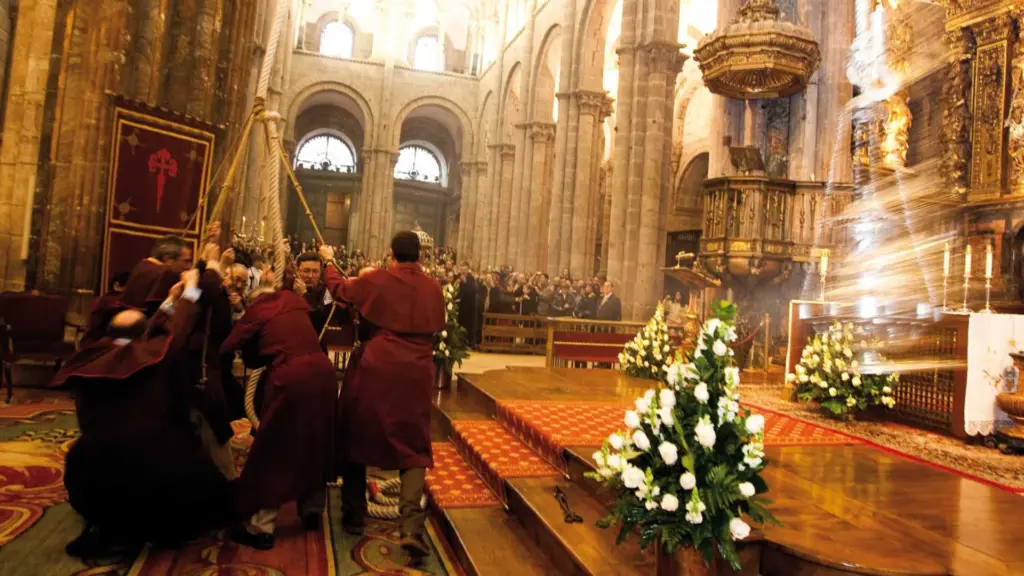
The Botafumeiro does not fly for free every day; the days when you can witness its flight are masses of major liturgical festivities such as:
- Three Kings’ Day (January 6)
- Easter Sunday
- The Ascension
- The Day of the Apostle (July 25)
- The Assumption (August 15)
- All Saints’ Day
- Christmas
If it is not on these calendar dates, the only way to see it in action is if a group, association, or individual covers the cost and books the demonstration. In these cases, the flight takes place during the Pilgrim’s Mass.
The incense: What aroma does the botafumeiro release?
The Botafumeiro releases a scent that floods the Santiago Cathedral, a dense, penetrating aroma with bitter undertones. This aroma is achieved by burning a mixture of natural resins (frankincense) over holm oak charcoal, generating a thick cloud of white smoke that the censer distributes throughout the entire temple at great speed.